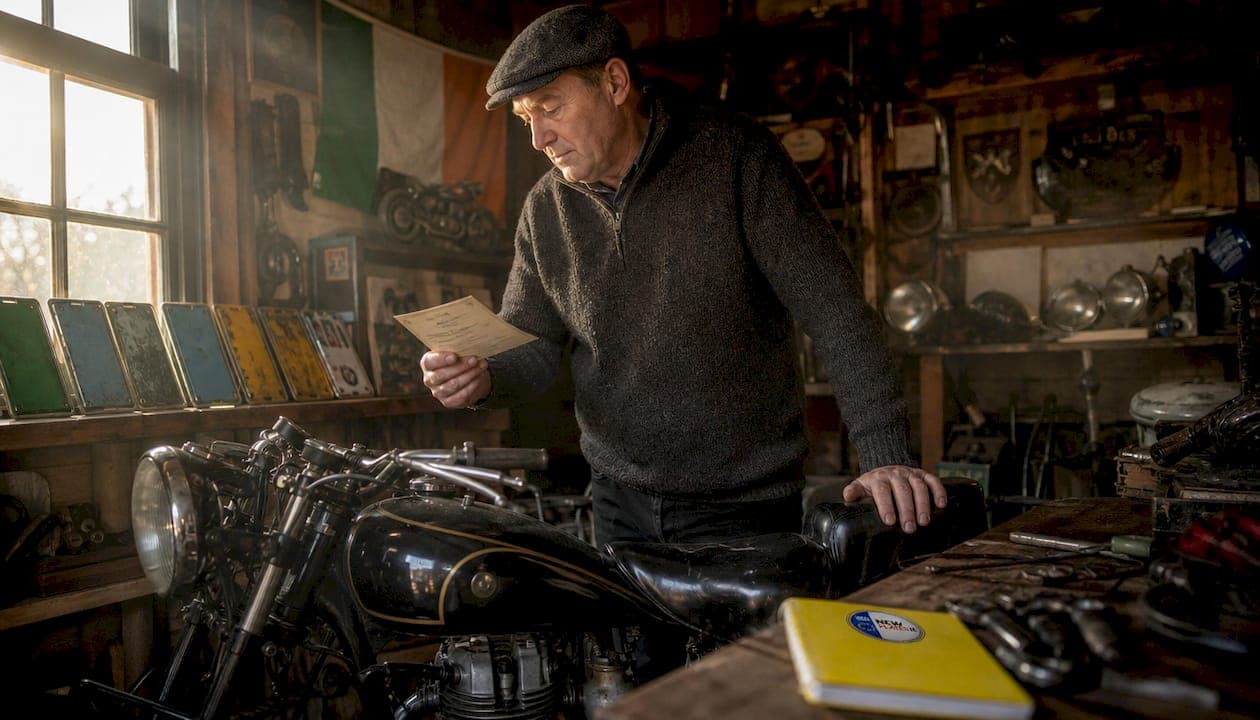
A vintage motorcycle plate is a legally recognized registration plate issued to motorcycles that qualify as historic under Irish law, based on their age, condition, and originality. This is the standard industry term for what collectors often call a classic bike license plate. In Ireland, this classification carries real legal weight. It affects how you register your bike, what fees you pay, and how you can legally use the machine on public roads. Whether you ride a 1970s Triumph or a barn-find Honda from the early 1980s, understanding vintage motorcycle registration is the first step to protecting both your investment and your legal standing.
What is a vintage motorcycle plate in Ireland?
A vintage motorcycle plate is assigned to a motorcycle that meets specific age and condition thresholds recognized by Irish authorities. The term "vintage" is not just a style label. It is a legal classification that determines how the vehicle is registered, taxed, and displayed on public roads.
In Ireland, the relevant authority for motor vehicle registration is the Road Safety Authority (RSA), working in conjunction with the Department of Transport. Motorcycles that qualify as historic vehicles generally need to be at least 30 years old, manufactured before a qualifying cutoff year, and maintained in a condition that reflects their original specification. The older the bike, the stronger the case for historic classification.

Age thresholds vary across jurisdictions. For context, age criteria for vintage status range from 15 to 45 years depending on the region. Ireland aligns broadly with European norms, where 30 years is the widely accepted minimum for historic vehicle status. That cutoff means bikes manufactured in 1996 or earlier are now entering eligibility territory in 2026.
The classification also differs from a standard plate, a show plate, or a custom display plate. A vintage registration plate is road legal and tied to the vehicle's official record. A show plate, by contrast, is purely decorative and cannot legally appear on a bike used on public roads.
Pro Tip: Check your motorcycle's Vehicle Registration Certificate (VRC) to confirm the original year of manufacture before starting any vintage registration application. Discrepancies between the VRC and the physical bike can cause significant delays.
What qualifies a motorcycle for vintage plate status in Ireland?
Eligibility for a vintage or historic motorcycle plate in Ireland rests on three pillars: age, condition, and documentation.
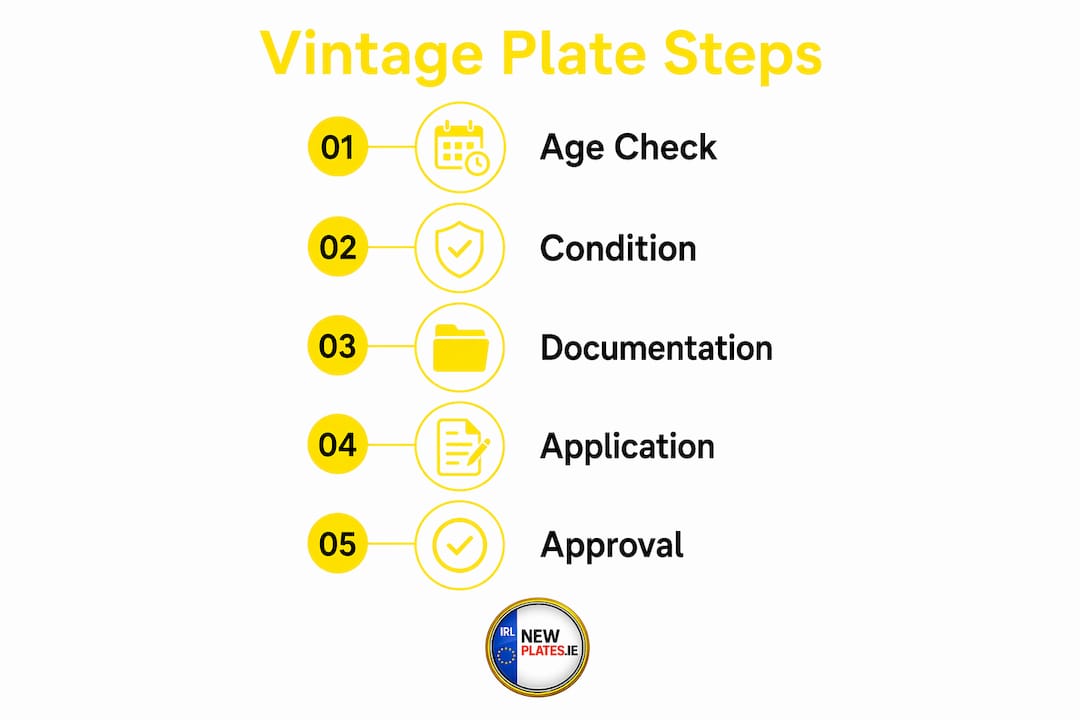
Age requirement. The motorcycle must generally be at least 30 years old. This aligns with the European Union's definition of a historic vehicle under Directive 2014/45/EU, which Ireland has adopted as part of its roadworthiness framework. Bikes manufactured before 1996 are the primary candidates in 2026.
Condition and originality. The motorcycle must be maintained in a historically correct condition. Significant modifications, particularly to the engine, frame, or bodywork, can disqualify a bike from historic status. Minor restorations that preserve the original specification are acceptable. Wholesale customization is not.
Documentation. You need to prove the bike is what you say it is. Required documents typically include:
- Original Vehicle Registration Certificate (VRC) or equivalent proof of ownership
- Evidence of the year of manufacture (logbook, manufacturer records, or club verification)
- VIN (Vehicle Identification Number) inspection confirmation
- Any previous registration history
For barn-find motorcycles with missing paperwork, archival logbooks and endorsements from authorized classic bike clubs are often required to prove authenticity. This is not a quick workaround. It is a formal process that carries legal responsibility.
Usage limitations. Vintage registration does not mean unlimited road use. Restrictions on annual mileage are common in many jurisdictions. Some regions cap annual mileage at 7,500 miles for vintage-registered vehicles. Irish regulations focus more on the vehicle's condition and appropriate use than on a hard mileage cap, but using a vintage-registered bike as a daily commuter is generally inconsistent with its classification.
Pro Tip: Joining a recognized Irish classic motorcycle club, such as the Irish Vintage Scene community, gives you access to expert members who can help verify your bike's authenticity and support your documentation if original records are incomplete.
What are the legal benefits and restrictions of vintage motorcycle plates in Ireland?
The benefits of vintage motorcycle plates are real and financially meaningful. The restrictions are equally real, and ignoring them is asking to be pulled over by the gardaí.
Benefits collectors actually care about
Reduced registration fees and exemption from emissions testing are the primary reasons collectors pursue vintage plate status. In Ireland, historic vehicles benefit from a reduced motor tax rate. As of 2026, motorcycles registered as pre-1980 vehicles qualify for a flat-rate annual motor tax, which is significantly lower than the standard rate applied to modern bikes.
Exemption from the National Car Test (NCT) is another major advantage. Motorcycles over 30 years old are generally exempt from the standard periodic roadworthiness inspection cycle that applies to newer vehicles. For more detail on how this works in practice, the rules around NCT exemptions for motorcycles are worth reviewing before you assume your bike qualifies automatically.
Insurance treatment also differs. Many Irish insurers offer agreed-value policies for historic motorcycles, which means the payout in a total-loss claim reflects the bike's collector value rather than its depreciated market value.
Restrictions you cannot ignore
- Vintage-registered motorcycles must be maintained in a condition consistent with their historic classification. Fitting modern aftermarket components that alter the bike's original character can invalidate the status.
- The plate itself must comply with Irish display regulations. Non-compliant plates, including oversized characters or unauthorized fonts, create legal exposure.
- Vintage registration numbers are non-transferable and permanently assigned to the motorcycle. You cannot sell the plate separately or transfer it to another vehicle.
- Using a vintage-registered bike commercially or as primary transport may conflict with the spirit of the classification and attract scrutiny.
The non-transferability point catches many collectors off guard. The plate becomes a permanent part of the bike's identity. That is actually a feature, not a flaw, because it reinforces the motorcycle's historic record.
How to get vintage plates for your motorcycle in Ireland
The registration process for a vintage motorcycle plate in Ireland follows a clear sequence. Cutting corners on any step creates delays that can stretch from weeks into months.
-
Confirm eligibility. Verify the motorcycle's year of manufacture against the 30-year threshold. Check the VRC and cross-reference with any available manufacturer records or club documentation.
-
Gather your documentation. Collect the original VRC, proof of ownership, VIN inspection records, and any supporting evidence of the bike's age and condition. Proper documentation including original titles and VIN inspections is critical. Missing paperwork is the single most common reason vintage plate applications stall.
-
Apply through the Motor Taxation Office. In Ireland, motor tax for historic vehicles is handled through your local Motor Taxation Office. You submit the RF100 or RF100A form along with supporting documents and pay the applicable historic vehicle motor tax rate.
-
Arrange a VIN inspection if required. If the bike's identity is in question, an authorized inspector may need to physically verify the VIN against registration records.
-
Obtain compliant plates. Once registration is confirmed, you need plates that meet Irish legal specifications. The plate must display the correct registration number in the correct format, using approved fonts and dimensions. This is where many enthusiasts make a costly mistake: ordering a plate that looks period-correct but does not meet current Irish road legal standards.
-
Switching from standard to vintage registration. If the bike is already registered under a standard plate, you apply to reclassify it as a historic vehicle. The existing registration number is retained and reassigned under the historic vehicle category.
Pro Tip: If your motorcycle lacks original documentation, contact a recognized Irish classic motorcycle club before approaching the Motor Taxation Office. A formal letter of provenance from a credible club carries real weight in the application process.
How do vintage motorcycle plates affect collector value and authenticity?
A vintage plate does more than reduce your tax bill. It functions as a formal declaration of the motorcycle's historic identity, and that declaration has measurable consequences for value, insurability, and participation in the classic bike community.
"Year of Manufacture plates allow preservation of period-correct appearances, which significantly boost collector value if properly verified. Plates must match registration documents to be legal."
Year of Manufacture (YOM) plates are a specific category that allows owners to display a plate styled to match the year the motorcycle was built. This matters enormously at classic rallies and concours events, where period correctness is judged and rewarded. A bike with a modern-format plate on a 1968 frame immediately signals something is off to experienced judges.
The collector value implications are significant:
- A correctly registered historic motorcycle with matching documentation commands a premium over an unregistered or incorrectly registered equivalent.
- Agreed-value insurance policies, which protect the collector's investment at full market value, typically require proof of historic registration status.
- Classic rally organizers and show committees often require valid vintage registration as a condition of entry.
- Vintage registration numbers are permanently assigned to the motorcycle, reinforcing the vehicle's unbroken historic identity.
One persistent misconception is that a vintage-style plate is the same as a legally registered vintage plate. It is not. A decorative plate that mimics a period-correct style but is not tied to a valid registration is illegal on a public road and does nothing for the bike's collector credentials. Many owners mistakenly treat vintage plates as decorative, but they legally signify historic status with real registration implications.
Vintage plate design requirements in Ireland
Irish law sets specific requirements for how a registration plate must look, regardless of whether the motorcycle is vintage or modern. The vintage classification does not grant freedom to use any plate style you find attractive.
| Design Element | Irish Legal Requirement |
|---|---|
| Character font | Charles Wright font (standard Irish specification) |
| Character height | Minimum 64mm for motorcycles |
| Background color | White (front), yellow (rear) for standard; historic vehicles follow the same rule unless otherwise specified |
| Reflective material | Required on road-legal plates |
| Border | Mandatory border around the plate |
| Plate material | Acrylic or metal; must be rigid |
The key point for vintage motorcycle collectors is that the plate must still meet current Irish road safety standards even if the bike is 50 years old. A hand-painted aluminum plate that looks authentic to 1965 is not road legal in Ireland in 2026. The motorbike plate regulations for historic vehicles differ from car plates in size and layout, so getting the right format matters.
Reflective backgrounds are mandatory. Non-reflective materials, regardless of how period-correct they look, are prohibited on public roads. If you want a display-only period-correct plate for shows, that is a separate product from your road-legal registration plate.
Key Takeaways
A vintage motorcycle plate in Ireland is a legally binding historic registration, not a style choice, and getting it right requires age verification, correct documentation, and compliant plate design.
| Point | Details |
|---|---|
| Age threshold | Motorcycles must generally be at least 30 years old to qualify for historic registration in Ireland. |
| Documentation is critical | Missing titles or VIN records are the most common reason vintage plate applications are delayed or rejected. |
| Plates are non-transferable | Vintage registration numbers are permanently assigned to the motorcycle and cannot be sold or swapped. |
| Design compliance is mandatory | Road-legal vintage plates must use the Charles Wright font, reflective backgrounds, and correct character heights. |
| Benefits are real but conditional | Historic vehicle status reduces motor tax and may exempt the bike from NCT, but the motorcycle must remain in original condition. |
Why getting vintage registration right matters more than most collectors realize
Patrick here. After years of watching enthusiasts go through the vintage registration process, the single biggest mistake I see is treating the plate as an afterthought. Collectors spend months sourcing the right bike, tracking down original parts, and restoring every detail to factory spec. Then they slap on a non-compliant plate and undo a significant portion of that work in one move.
The plate is not decoration. It is the bike's legal identity. A vintage registration number that is permanently assigned to your motorcycle becomes part of its provenance. Future buyers, insurers, and show organizers will check it. Getting it wrong creates a paper trail that is genuinely difficult to clean up.
My honest advice: engage with a recognized classic motorcycle club early in the process. The members have navigated the same paperwork you are facing, and their endorsements carry real weight with the Motor Taxation Office. Do not wait until you have a problem to ask for help. The Irish classic bike community is generous with knowledge, and that generosity is worth using.
The other thing I would say is this: do not confuse a show plate with a road-legal plate. They serve completely different purposes. A beautiful period-correct display plate belongs on the wall of your garage or on the bike at a static show. Your road-legal plate belongs on the bike every time it leaves your driveway.
— Patrick
Newplates can help you get your vintage plate right
Getting a compliant plate for your vintage motorcycle does not need to be complicated. Newplates produces road-legal motorbike number plates that meet Irish regulations, including the correct font, character height, reflective background, and border specifications that the law requires.

Whether you need a standard NCT-compliant plate or want to explore options like 4D legal plates for a distinctive finish that still meets Irish road standards, Newplates has the range to cover it. Prices start from €15.99, and the ordering process is straightforward. You enter your registration, choose your plate style, and receive a plate built to the correct specification. No guesswork about compliance. No risk of ordering something that looks great but fails a roadside check.
FAQ
What is the minimum age for a vintage motorcycle plate in Ireland?
Motorcycles must generally be at least 30 years old to qualify for historic vehicle classification in Ireland, aligning with the European Union's definition under Directive 2014/45/EU.
Are vintage motorcycle plates exempt from the NCT in Ireland?
Motorcycles over 30 years old are generally exempt from the standard NCT inspection cycle in Ireland, though the motorcycle must still be maintained in a roadworthy condition.
Can I transfer a vintage motorcycle registration plate to another bike?
No. Vintage registration numbers are non-transferable and permanently assigned to the motorcycle. They cannot be sold or moved to a different vehicle.
What documents do I need to apply for vintage plates in Ireland?
You need the original Vehicle Registration Certificate, proof of ownership, VIN inspection records, and evidence of the year of manufacture. For bikes with missing documentation, a letter of provenance from a recognized classic motorcycle club is often required.
Is a vintage-style show plate the same as a legal vintage registration plate?
No. A show plate is decorative and cannot legally appear on a motorcycle used on public roads. A legal vintage registration plate is tied to the vehicle's official registration record and must meet all Irish display and design standards.