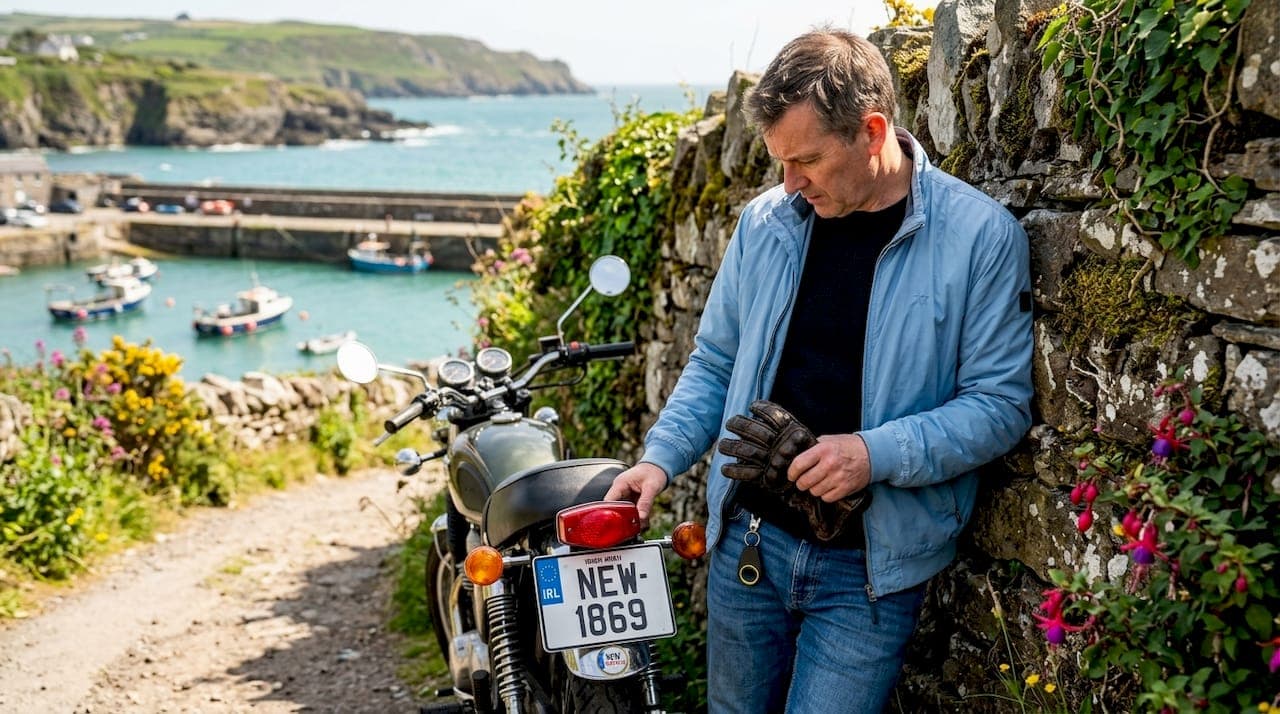
Motorcycle plate compliance in Ireland is governed by Revenue, not the National Car Test. This is the single most important fact Irish riders need to understand. The NCT applies to passenger cars, and motorcycles are exempt from mandatory NCT roadworthiness testing entirely. That means no NCT inspector will ever check your bike's plate for legibility or format. What does apply, firmly and with real financial consequences, are Revenue's statutory plate standards. Understanding how NCT applies to motorcycle plates, or more accurately, why it does not, is the starting point for every rider who wants to stay legal on Irish roads.
How NCT testing relates to motorcycle number plates in Ireland
The National Car Test covers category M1 passenger vehicles. Commercial vehicles fall under the Commercial Vehicle Roadworthiness Test (CVRT). Motorcycles sit outside both of these mandatory testing schemes. That is not a loophole. It is simply how Irish vehicle inspection law is structured.
Because motorcycles are outside NCT testing, no NCT report is generated for your bike. NCT reports for cars include a plate legibility check, confirming characters are readable and lighting is functional. Motorcycle riders never go through that process, so there is no NCT plate check to pass or fail.
A second source of confusion is the difference between the NCT and the NCTS. The National Car Testing Service (NCTS) operates the registration inspection centers where motorcycles are assigned their registration numbers. That is a registration function, not a roadworthiness test. NCTS registration and NCT roadworthiness testing are completely separate processes with different compliance scopes.
- The NCT tests cars for roadworthiness, including plate checks.
- The NCTS assigns registration numbers to all vehicles, including motorcycles.
- Motorcycles do not undergo NCT roadworthiness testing at any point.
- Motorcycle plate compliance is enforced by Revenue and the Gardaí on the road.
Pro Tip: If someone tells you your motorcycle plate needs to be "NCT compliant," they are mixing up two different systems. Your plate needs to be Revenue compliant. That is the standard that matters.
What are the legal standards for motorcycle plates in Ireland?
Revenue sets the legal requirements for all registration plates in Ireland under S.I. No. 318 of 1992. These rules apply to motorcycles just as they apply to cars, even though the enforcement mechanism differs. Ignoring them is not a minor oversight. Non-compliant plates can result in fines of up to €5,000 under Irish law. That is a serious penalty for what many riders dismiss as a cosmetic choice.
Rear plate only: what motorcycles must display
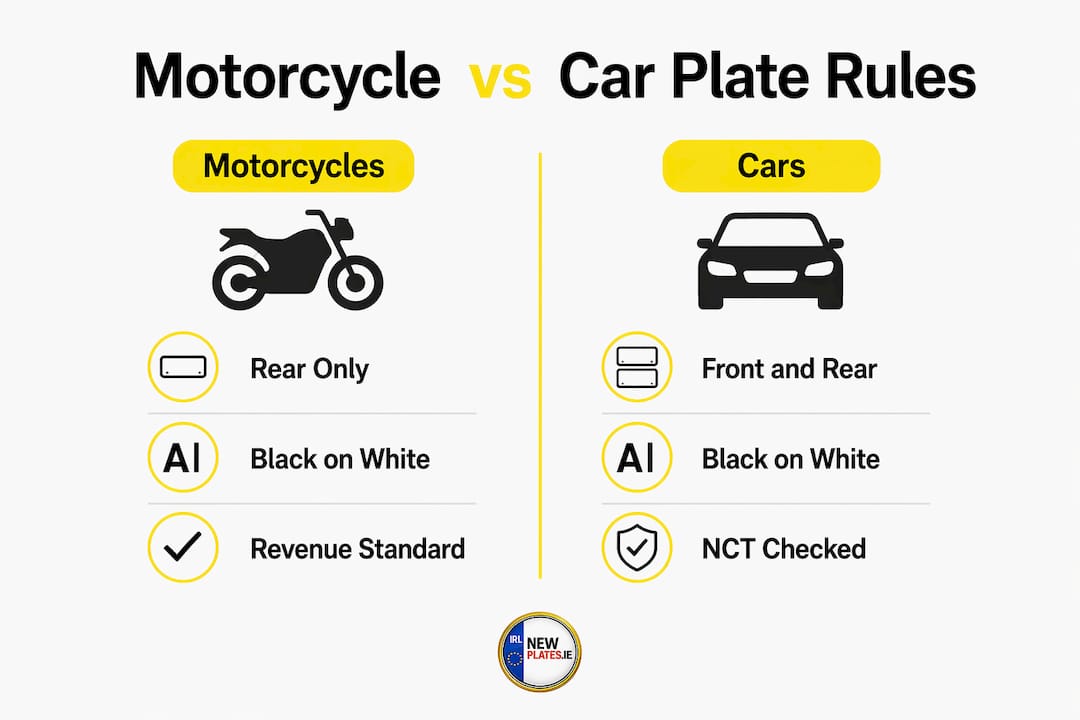
Irish motorcycles are only required to display a rear registration plate. No front plate is required, which makes sense given the single front wheel design of most bikes. This is one of the clearest differences between motorcycle and car plate rules in Ireland.
Format and materials requirements
The statutory format for Irish registration plates includes several non-negotiable elements:
- Black characters on a white reflective background. No colored backgrounds, no dark characters on dark surfaces.
- County name displayed in Irish. For example, "BÁC" for Dublin, "CGE" for Kildare.
- EU flag with "IRL" identifier. This must appear on the left side of the plate.
- Correct character dimensions. Digit height, stroke width, and spacing are all specified in statute.
- Reflective material throughout. The background must meet reflectivity standards for nighttime visibility.
Registration date affects plate format
Plate format depends on registration date. Motorcycles registered since january 1, 2013 use the YY1/YY2 style, where the number indicates the first or second half of the year. Bikes registered before that date use the older YY-County-Sequential format. Ordering a plate that does not match your registration year format is a compliance failure, regardless of how good it looks.
| Requirement | Standard |
|---|---|
| Plate position | Rear only for motorcycles |
| Character color | Black on white reflective background |
| County identifier | Irish language abbreviation |
| EU/IRL marking | Required on left side |
| Penalty for non-compliance | Up to €5,000 |
Can you customize your motorcycle plate and stay legal?
Yes, you can customize your motorcycle plate. Revenue does not supply plates directly. After your bike is registered and you have your registration number, you can order plates from any supplier who meets the statutory format and visibility standards. That freedom is real, but it comes with responsibility.
The most common mistake riders make is choosing a plate that looks great but breaks one or more legal rules. Colored backgrounds, non-standard fonts, oversized or undersized characters, and missing EU/IRL markings are all grounds for a fine. The Gardaí can stop you and issue a penalty on the spot. No NCT test is needed to catch a non-compliant plate.
When choosing a supplier, check these points before ordering:
- Does the supplier use a white reflective background as standard?
- Are the character dimensions correct for Irish plates?
- Does the plate include the county name in Irish and the EU/IRL identifier?
- Does the supplier confirm the plate meets S.I. No. 318 of 1992 requirements?
Rear plate visibility is especially important for motorcycles because it is the only plate on the bike. A plate that is dirty, faded, or poorly lit at night is a compliance risk and a safety issue. Reflective materials are not optional. They are a legal requirement.
Pro Tip: Ask your supplier directly whether their plates comply with Irish Revenue standards. A reputable supplier will confirm this without hesitation. If they cannot answer clearly, order elsewhere.
How do motorcycle plate rules compare to car plate rules under NCT?
The differences between motorcycle and car plate requirements in Ireland are more significant than most riders realize. Cars must display both a front and rear plate. Motorcycles display only a rear plate. That single difference changes the entire compliance picture.
For cars, NCT plate checks are part of the roadworthiness inspection. An NCT tester will flag a car with an illegible plate, missing characters, or non-standard format. That creates a built-in compliance checkpoint for car owners every time their vehicle goes through the test. Motorcycle riders have no equivalent checkpoint. Compliance is entirely self-managed, with enforcement happening through Garda roadside checks rather than scheduled inspections.
This is why the motorcycle compliance approach requires more proactive attention from riders. There is no annual test reminding you to check your plate. You need to verify it yourself.
| Requirement | Motorcycles | Cars |
|---|---|---|
| Plates required | Rear only | Front and rear |
| NCT plate check | Not applicable | Required at NCT |
| Compliance enforced by | Revenue and Gardaí | Revenue, Gardaí, and NCT |
| Plate format standard | S.I. No. 318 of 1992 | S.I. No. 318 of 1992 |
| Penalty for non-compliance | Up to €5,000 | Up to €5,000 |
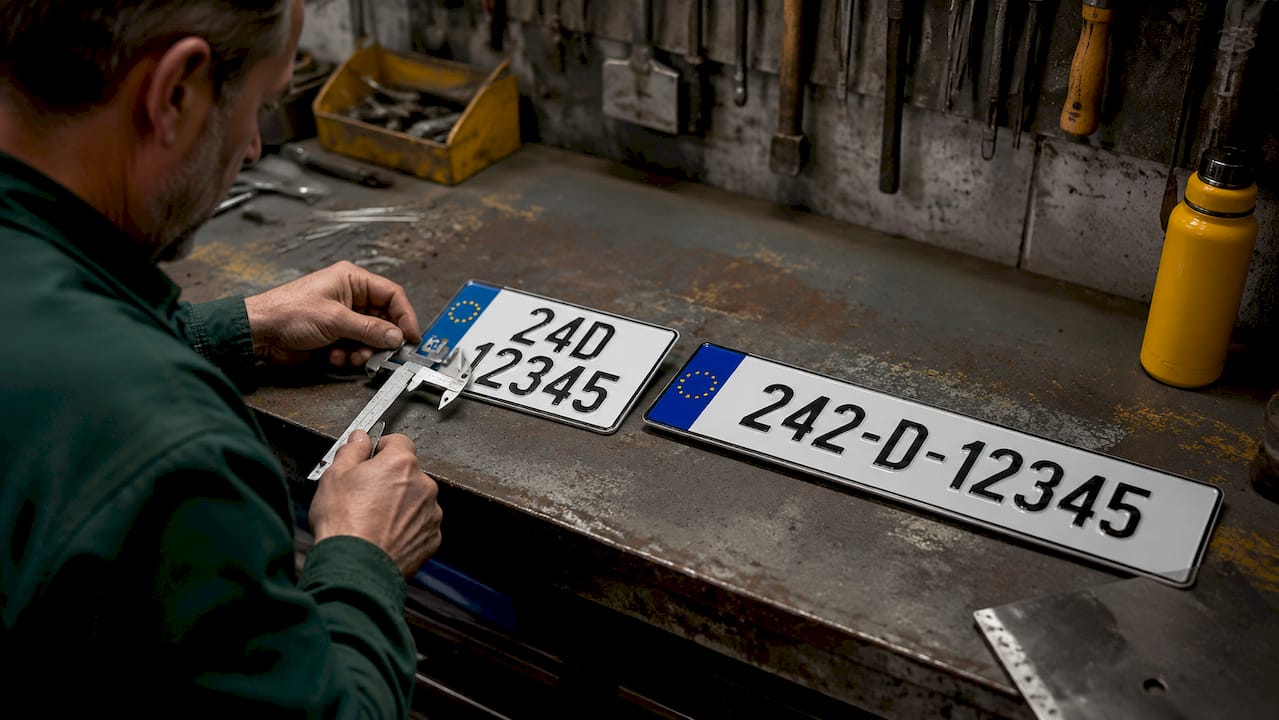
Both motorcycles and cars share the same Revenue format standards. The difference is in how and when those standards are checked. For more detail on why motorbike plates differ from cars, the format distinctions go deeper than just plate count.
Practical steps to keep your motorcycle plate legal in Ireland
Getting your plate right from the start is far easier than dealing with a fine later. Follow these steps to stay on the right side of Revenue and the Gardaí.
- Register your motorcycle at an NCTS center. This is where your registration number is assigned. Without this step, you have no legal plate number to display.
- Order your plate from a compliant supplier after registration. Confirm the supplier meets Irish statutory standards before placing your order. Newplates offers road legal motorbike plates built to Irish specifications.
- Check the plate format against your registration date. Bikes registered from january 2013 onward use the YY1/YY2 format. Older bikes use the previous format. Mismatched formats are non-compliant.
- Fit the plate correctly on the rear of the bike. The plate must be clearly visible and securely mounted. A guide on fitting your motorcycle plate covers the practical details.
- Inspect the plate regularly. Check for fading, cracking, or dirt buildup that reduces legibility. A plate that was compliant when new can become non-compliant through wear.
Garda enforcement of plate standards happens on the road, not in a testing center. Riders who assume their plate is fine because they have never been stopped are taking a risk. The €5,000 fine is the maximum, but even lower penalties are worth avoiding entirely.
Key Takeaways
Motorcycle plate compliance in Ireland is enforced by Revenue and the Gardaí, not the NCT, making Revenue's format standards the only legal benchmark riders need to follow.
| Point | Details |
|---|---|
| NCT does not apply to motorcycles | Motorcycles are exempt from mandatory NCT testing; plate compliance is Revenue's domain. |
| Rear plate only required | Irish motorcycles legally display only a rear plate, unlike cars which need front and rear. |
| Revenue sets the format standard | S.I. No. 318 of 1992 governs character color, size, reflectivity, and county markings. |
| Fines reach up to €5,000 | Non-compliant plates carry serious financial penalties enforced by the Gardaí on the road. |
| Any compliant supplier is valid | Revenue does not issue plates; riders can order from any supplier meeting statutory specs. |
The NCT confusion is costing Irish riders more than they think
Riders ask about NCT compliance for motorcycle plates more often than you might expect. The confusion is understandable. The NCT is the most visible vehicle compliance system in Ireland, and the NCTS centers handle motorcycle registration. It is easy to conflate the two.
What concerns me more is the downstream effect of that confusion. Riders who believe their plate only matters at an NCT test have no reason to check it between rides. They assume the system will catch any problem. But for motorcycles, there is no scheduled catch. The Gardaí are the checkpoint, and they can stop you any time.
The other issue I see regularly is riders ordering plates from suppliers who do not clearly state Irish compliance. A plate that looks legal is not the same as a plate that is legal. The reflective background, the county name in Irish, the EU/IRL marking, the correct character dimensions: these are not suggestions. They are statutory requirements under S.I. No. 318 of 1992.
My honest advice is to treat your rear plate as the single most important compliance item on your bike. It is the only plate you have, and it is always visible. Get it right from a supplier who knows Irish law, check it regularly, and do not assume that because no NCT test applies to your motorcycle, the rules are somehow softer. They are not.
— Patrick
Newplates has legal motorcycle plates ready to order
Irish motorcyclists who want a plate that looks sharp and passes any roadside check have a straightforward option with Newplates. Every plate is built to Irish Revenue standards, covering reflective backgrounds, correct character dimensions, and the required EU/IRL and county markings.
Newplates offers a full range of motorbike number plates designed specifically for rear display on Irish bikes. For riders who want something with more visual presence, the 3D gel plate range delivers a premium finish while staying within legal specifications. Prices start at €15.99 for standard plates, and ordering online takes minutes once you have your registration number. No guesswork on compliance. Just a legal plate, built for your bike.
FAQ
Are motorcycles required to take the NCT in Ireland?
No. Motorcycles in Ireland are exempt from mandatory NCT roadworthiness testing. The NCT applies to passenger cars and certain commercial vehicles, not motorcycles.
What legal standard governs motorcycle plates in Ireland?
Revenue's plate format requirements under S.I. No. 318 of 1992 govern all Irish motorcycle plates. These rules cover character color, reflective background, county markings, and EU/IRL identifiers.
Do motorcycles need a front number plate in Ireland?
No. Irish motorcycles are only required to display a rear registration plate. Front plates are not required for motorcycles under Irish law.
What is the fine for a non-compliant motorcycle plate?
Displaying a non-compliant plate in Ireland can result in a fine of up to €5,000. The Gardaí enforce this on the road, independent of any NCT process.
Can I order a custom motorcycle plate from any supplier?
Yes, as long as the supplier meets Irish statutory format and visibility standards. Revenue does not supply plates directly, so riders are free to order from any compliant source after registration.