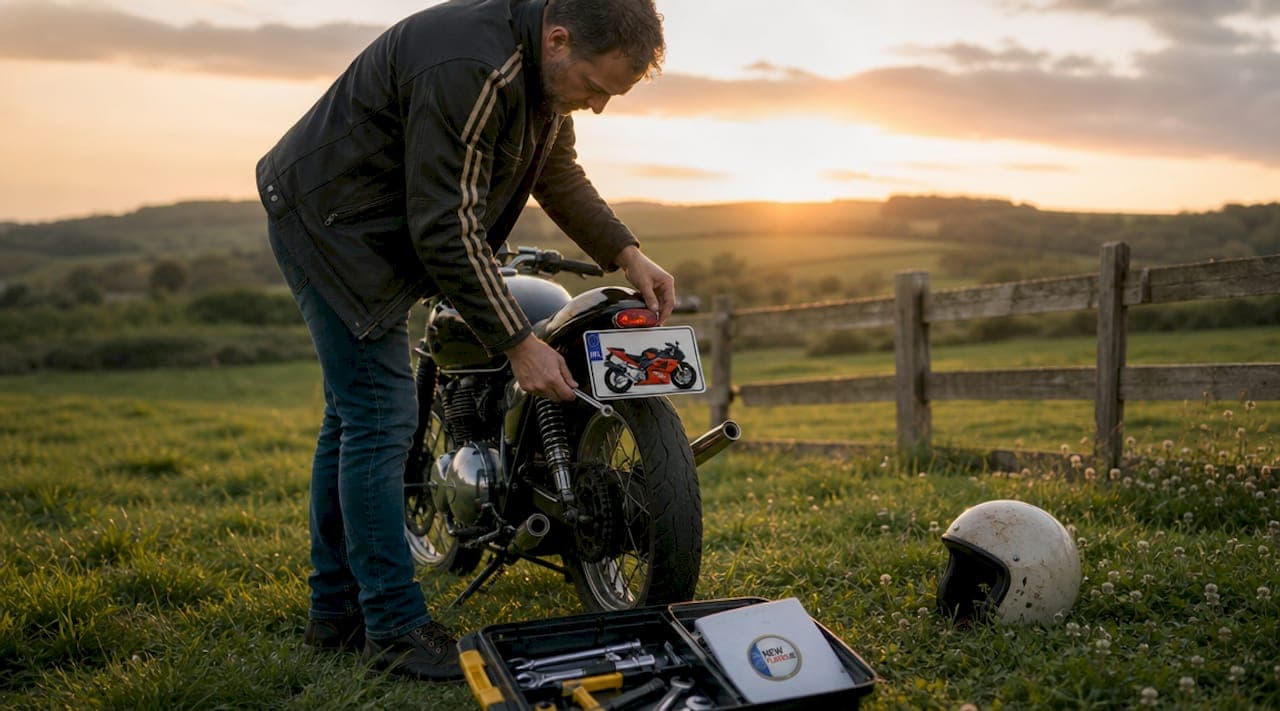
Motorbike show plates are decorative number plates produced exclusively for off-road use, exhibitions, and private display. They are not legally permitted on public roads in Ireland. If you have ever spotted a bike at a custom show with a plate featuring a skull graphic, a neon background, or a font that looks nothing like the standard issue, that is a show plate. They exist in a completely separate category from road-legal registration plates, and understanding that distinction matters a lot if you want to avoid a conversation with the Gardaí that ends with your bike on a flatbed. This guide covers what motorbike show plates are, how they differ from legal plates, what customization options exist, and what every Irish motorcyclist needs to know before fitting one.
What are motorbike show plates and how are they defined?
Motorbike show plates are custom-designed display plates made for aesthetic purposes only. They are not road-legal, and fitting one on a public road can result in fines of up to €1,000 and vehicle seizure. That is not a grey area. The law is clear, and the responsibility sits entirely with the rider.
Show plates go by several names: motorbike display plates, motorcycle show plates, and custom bike plates. All refer to the same product. They are typically ordered for bike shows, photoshoots, racing events, garage displays, or as collector pieces. Some riders order them to preview how a personalized registration would look before committing to the real thing.
What makes them attractive is exactly what makes them illegal for road use. Show plates can feature non-standard fonts, tinted or colored backgrounds, custom logos, and finishes like 3D gel or 4D acrylic that fall outside official Irish plate specifications. Custom designs allow riders to express identity through color, graphics, and finish in ways that a standard road plate simply cannot accommodate.
What are the legal requirements for motorbike number plates on Irish public roads?
Irish road-legal motorbike plates follow strict technical standards that leave very little room for creativity. Characters must be 64mm high in the Charles Wright font, arranged in a mandatory two-line format. That 64mm height compares to 79mm for car plates, reflecting the smaller physical dimensions of a motorcycle plate while still meeting ANPR (Automatic Number Plate Recognition) readability requirements.
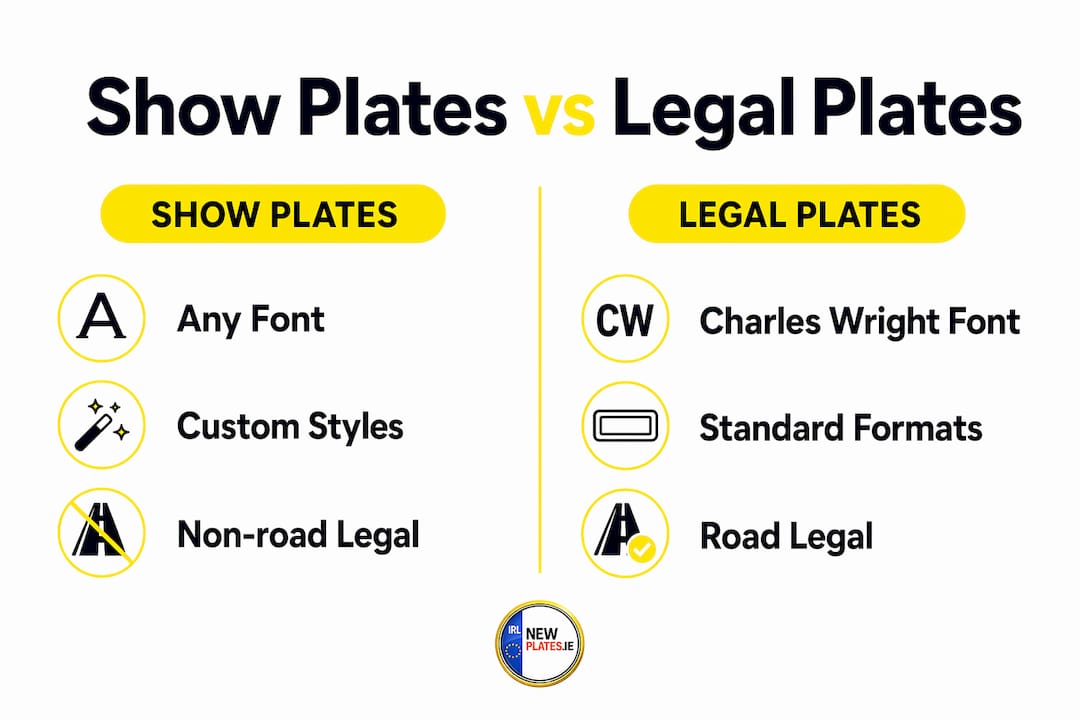
The two-line format is not optional. Single-line formats are automatic compliance failures under Irish regulations. This is one of the most commonly misunderstood rules, and we have seen riders fit plates that look fine to the human eye but fail the moment a camera reads them.
Beyond character size and layout, legal plates must also display the supplier's name, postcode, and standard mark printed on the plate itself. These details confirm the plate was produced by a registered manufacturer and meets the required standard. A plate without them is non-compliant, regardless of how good it looks.
The consequences of riding with a non-compliant plate are serious:
- Fines reaching €1,000 for illegal plate use on public roads
- Vehicle impoundment if a Garda stops you and the plate fails inspection
- NCT failure if your plate does not meet the required specifications
- Personal liability, since the rider is always responsible for the legality of the plate fitted to their bike
Pro Tip: Before fitting any plate to your motorbike, check that it carries the supplier's details and meets the two-line format requirement. If it does not have those printed details, it is not road-legal, full stop.
How do motorbike show plates differ from legal road plates?
The differences between show plates and road-legal plates go beyond aesthetics. They are fundamentally different products built for different purposes.
| Feature | Road-Legal Plate | Show Plate |
|---|---|---|
| Font | Charles Wright only | Any font, custom styles |
| Background | White (front) or yellow (rear), reflective | Any color or finish |
| Character size | 64mm height, strict spacing | No restriction |
| Supplier details | Mandatory | Not required |
| Standard mark | Required | Not required |
| Legal for public roads | Yes | No |
Non-standard fonts and backgrounds are the most visible differences, but the absence of a standard mark is the legal one. A show plate has no obligation to carry any certification because it is never intended for road use.
One common misconception is that a show plate becomes road-legal if it displays a real registration number. It does not. Using a show plate for a personalized registration on a public road is illegal and is a mistake riders make more often than you might expect. The registration number being genuine does not change the legal status of the plate it is printed on.
Another misconception involves online sellers. Some sellers market show plates ambiguously, using language that implies road legality without stating it directly. The rider carries full legal responsibility for whatever plate is fitted to their bike. If you are unsure, ask the supplier directly whether the plate meets Irish road standards.
Pro Tip: If a plate listing does not explicitly state it is road-legal and compliant with Irish regulations, treat it as a show plate. The burden of proof is on you, not the seller.
What customization options do show plates offer for personalizing your motorbike?
Show plates are where creativity has no ceiling. Because they are not bound by road-legal specifications, the design options are genuinely open-ended. Show plates act as a blank canvas for riders to express their identity through registration plate design, and the range of choices available in 2026 is wider than ever.
Here is what you can typically customize on a show plate:
- Fonts: Script fonts, gothic lettering, block styles, or any custom typeface
- Background colors: Matte black, carbon fiber effect, chrome, color gradients, or custom imagery
- Finishes: 3D gel raised lettering, 4D laser-cut acrylic characters, tinted overlays
- Graphics and logos: Club badges, brand logos, custom artwork, or flag designs
- Border styles: Decorative frames, colored borders, or no border at all
- Text additions: Nicknames, slogans, or custom text alongside the registration number
Popular choices among Irish motorcyclists include carbon fiber backgrounds with gold 3D gel characters, matte black plates with white lettering for a stealth look, and plates featuring county or club insignia. Some riders order show plates that mirror the color scheme of their bike's bodywork, creating a fully coordinated visual identity.
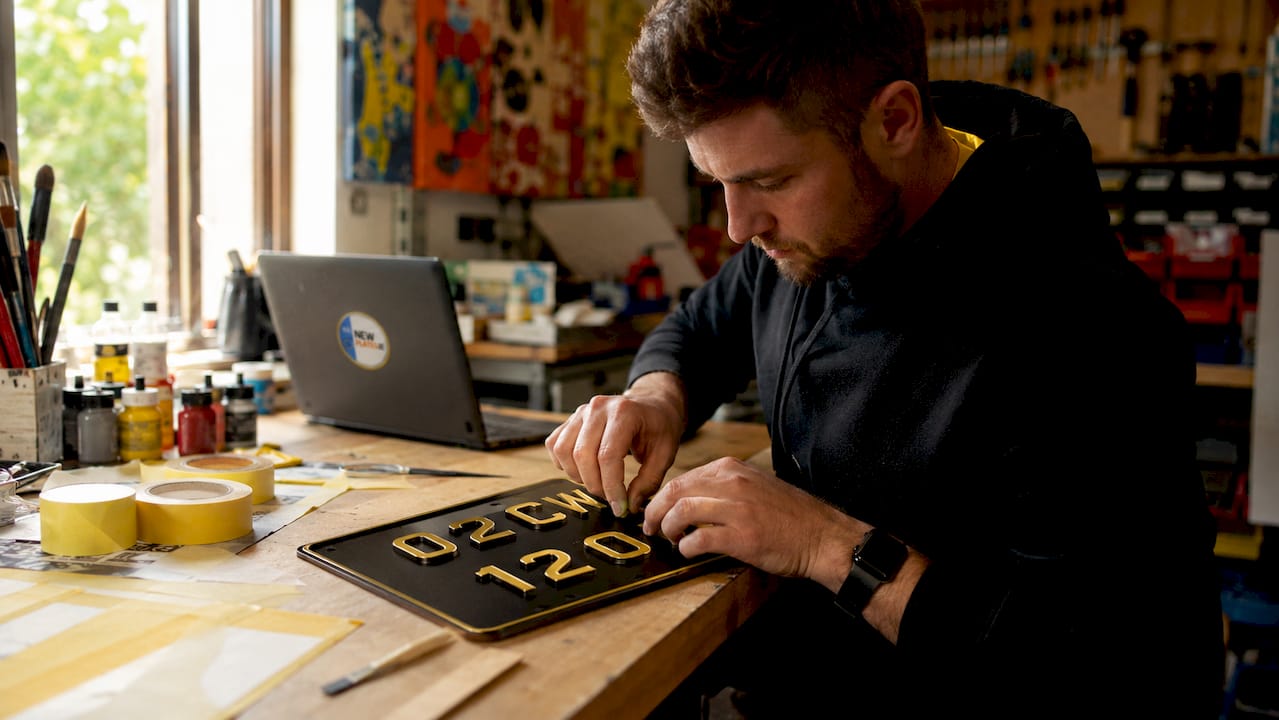
The finishing options deserve special attention. 3D gel plates use a raised resin dome over each character, giving a tactile, premium look. 4D acrylic plates use laser-cut characters that sit proud of the plate surface for an even more dramatic effect. Both finishes are available through Newplates and can be applied to show plates without any compliance restrictions.
Pro Tip: Order a show plate first if you are considering a personalized registration. It lets you preview the exact look of your chosen number before spending money on the official registration transfer.
Can 3D and 4D styled plates be road legal or are they always show plates?
This is one of the most searched questions in the Irish motorcycle community, and the answer is more nuanced than most people expect. 3D and 4D styled plates are not automatically show plates. They can be legally compliant if they meet the required font, size, spacing, and background standards.
Industry specialists confirm that stylish designs on legal plates are achievable when the plate is produced by a registered supplier using compliant materials and dimensions. The style of the character finish does not automatically disqualify a plate. What matters is whether the underlying specifications are met.
To verify whether a 3D or 4D plate is road-legal, check for the following:
- Characters are in the Charles Wright font at 64mm height
- The plate uses a white reflective background (front) or yellow reflective background (rear)
- The two-line format is used for motorcycle plates
- The supplier's name, postcode, and standard mark are printed on the plate
- Character spacing meets the required measurements
The biggest mistake riders make is assuming that any 3D or 4D plate is road-legal. Careful verification of supplier details, dimensions, and compliance markings is the only way to be certain. A plate that looks legal is not the same as a plate that is legal.
Newplates offers 4D legal plates that meet Irish road standards, so you do not have to choose between style and compliance. The key is buying from a supplier who is transparent about what their plates are certified for.
Practical advice for motorcyclists considering show plates in Ireland
If you are thinking about ordering a show plate, the process is straightforward as long as you are clear on what you are buying and how you intend to use it.
Show plates are perfectly legal to own, display in your garage, use at bike shows, or feature in photoshoots. The legal issue arises only when they are fitted to a bike on a public road. Keep that boundary clear and you will have no problems.
Here is what to keep in mind:
- Confirm the intended use before ordering. If you want a plate for road use, order a road-legal plate. If you want one for display, a show plate is the right product.
- Buy from a registered supplier. Reputable suppliers like Newplates are transparent about which products are road-legal and which are for display only. Avoid sellers who are vague about compliance.
- Never fit a show plate to a bike you ride on public roads, even temporarily. The Gardaí do not accept "I forgot to swap it back" as a defense.
- Store and display show plates carefully. Acrylic and gel finishes can scratch if stored loosely. Use a protective sleeve or mount them on a display board.
- Check how to fit a number plate correctly if you are installing a road-legal plate, since improper mounting can itself create compliance issues.
If you are transporting your motorcycle to a show or event where you plan to display a show plate, make sure the road-legal plate is fitted during transit and only swap to the show plate once the bike is off the public road.
Key takeaways
Motorbike show plates are legal to own and display but are never road-legal in Ireland, and the rider bears full responsibility for any plate fitted to their bike on a public road.
| Point | Details |
|---|---|
| Show plates are display-only | They cannot be used on public Irish roads under any circumstances. |
| Road-legal plates have strict specs | Two-line format, 64mm characters, Charles Wright font, and supplier details are all mandatory. |
| 3D and 4D plates can be road-legal | Compliance depends on font, size, background, and supplier certification, not the finish style. |
| Show plates offer full design freedom | Custom fonts, colors, graphics, and finishes are all available without legal restriction. |
| Rider responsibility is absolute | No seller disclaimer removes your legal liability for a non-compliant plate on your bike. |
Why show plates deserve more respect than they get
From where I sit, show plates occupy a genuinely interesting space in motorcycle culture that gets dismissed too quickly. Most of the conversation around them focuses on what you cannot do, which is fair enough from a legal standpoint. But the creative side of the story is worth telling.
We have seen riders use show plates to build a complete visual identity around their bike. A matte black plate with custom lettering that matches the tank graphics is not just decoration. It signals that the owner has thought carefully about every detail of the build. That kind of attention is exactly what separates a bike that turns heads at a show from one that blends into the background.
The tension between customization and compliance is real, but it is not as limiting as people assume. With suppliers like Newplates offering road-legal motorbike plates in 3D and 4D finishes that meet Irish standards, you can have a plate that looks custom without the legal risk. The riders who get into trouble are usually the ones who did not ask the right questions before fitting a plate they bought from an unclear source.
My honest recommendation: order a show plate for the garage wall and a compliant styled plate for the road. You get the best of both without asking for a fine you do not need.
— Patrick
Get your custom or show plate from Newplates
Newplates has a full range of options whether you are after a display piece for your next bike show or a road-legal plate that still turns heads. Their custom number plates cover everything from standard compliant designs to 3D and 4D finishes built to Irish road standards. For riders who want something purely for display, the custom show plates range offers complete design freedom with no compromise on quality. Prices start from €15.99, and every product is backed by clear guidance on what is road-legal and what is for display only. If you want a plate that reflects your bike's personality without the legal headache, Newplates is the place to start.
FAQ
What are motorbike show plates used for?
Motorbike show plates are used for exhibitions, bike shows, photoshoots, garage displays, and private collections. They are not road-legal and cannot be fitted to a motorcycle used on public Irish roads.
Are show plates legal to own in Ireland?
Yes, show plates are legal to own and display in a private setting. The legal issue arises only when they are fitted to a motorcycle on a public road, which can result in fines of up to €1,000 and vehicle seizure.
Can I use a show plate with my real registration number?
No. Displaying a genuine registration number on a non-compliant show plate on a public road is still illegal. The plate itself must meet all legal standards, regardless of whether the registration number is real.
Are 3D and 4D plates always show plates?
No. 3D and 4D plates can be road-legal if they use the correct font, character size, reflective background, and carry the supplier's compliance details. The finish style alone does not determine legality.
What font is required on a legal Irish motorbike plate?
Legal Irish motorbike plates must use the Charles Wright font with characters 64mm high in a mandatory two-line format. Any other font makes the plate non-compliant for road use.