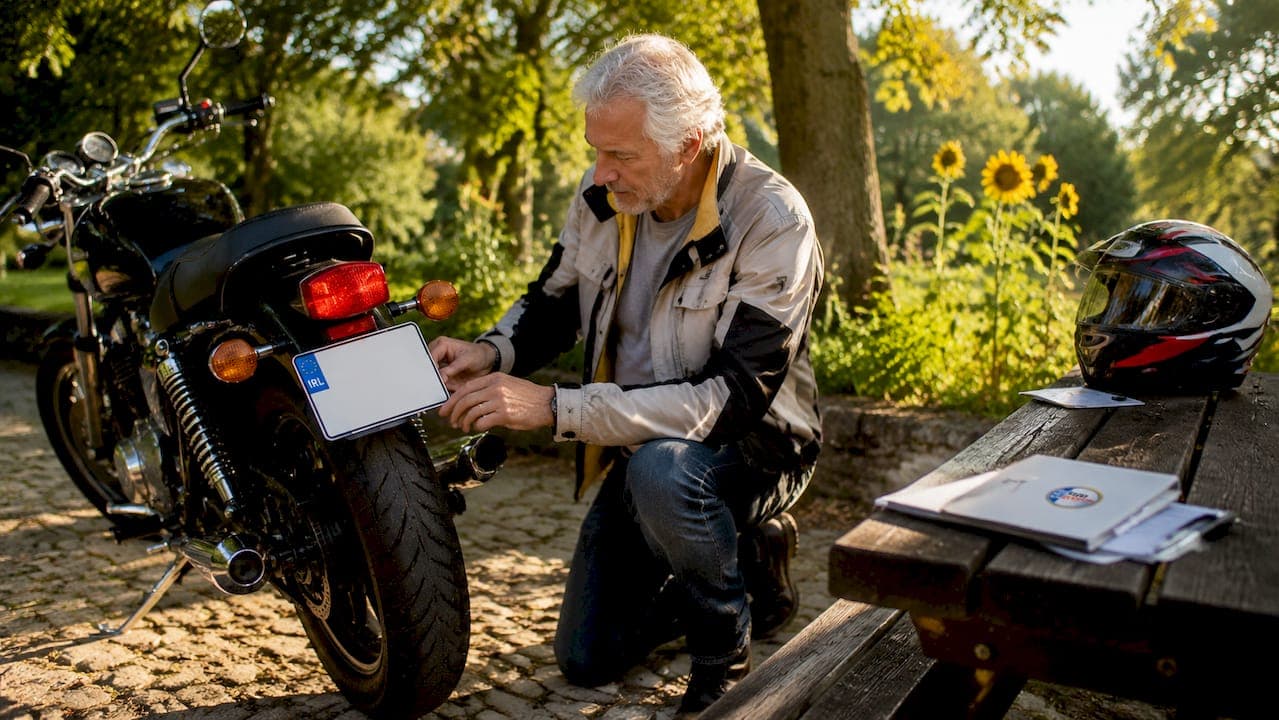
Motorbike license plates differ from car plates because motorcycles have fundamentally different physical constraints, mounting limitations, and exposure conditions that demand a distinct registration plate standard. In Ireland, these differences are codified in law, meaning a plate that works perfectly on a Toyota Corolla would be illegal on a Honda CB500. Understanding why motorbike plates differ from cars is not just trivia for enthusiasts. It directly affects whether your bike passes an NCT inspection, whether the gardaí can read your plate at speed, and whether an ANPR camera can identify your vehicle accurately. The rules are specific, the tolerances are tight, and the consequences of getting it wrong are real.
Why motorbike plates differ from cars: size, layout, and font
The most immediate difference between motorbike and car plates in Ireland is physical size. Motorcycle plates measure 228mm x 178mm, while standard car plates run 520mm x 111mm. That is not a minor adjustment. It is a completely different plate format designed around the narrow rear panels of motorcycles, where a full-width car plate simply cannot fit.
Character size follows the same logic. Motorcycles use 64mm character height, while cars use 79mm height characters in Ireland. Smaller characters on a smaller plate still need to be readable at distance, which is why the two-line layout exists. Stacking the registration number across two lines allows each character to remain large enough for legibility without requiring a plate wider than the bike's tail section.
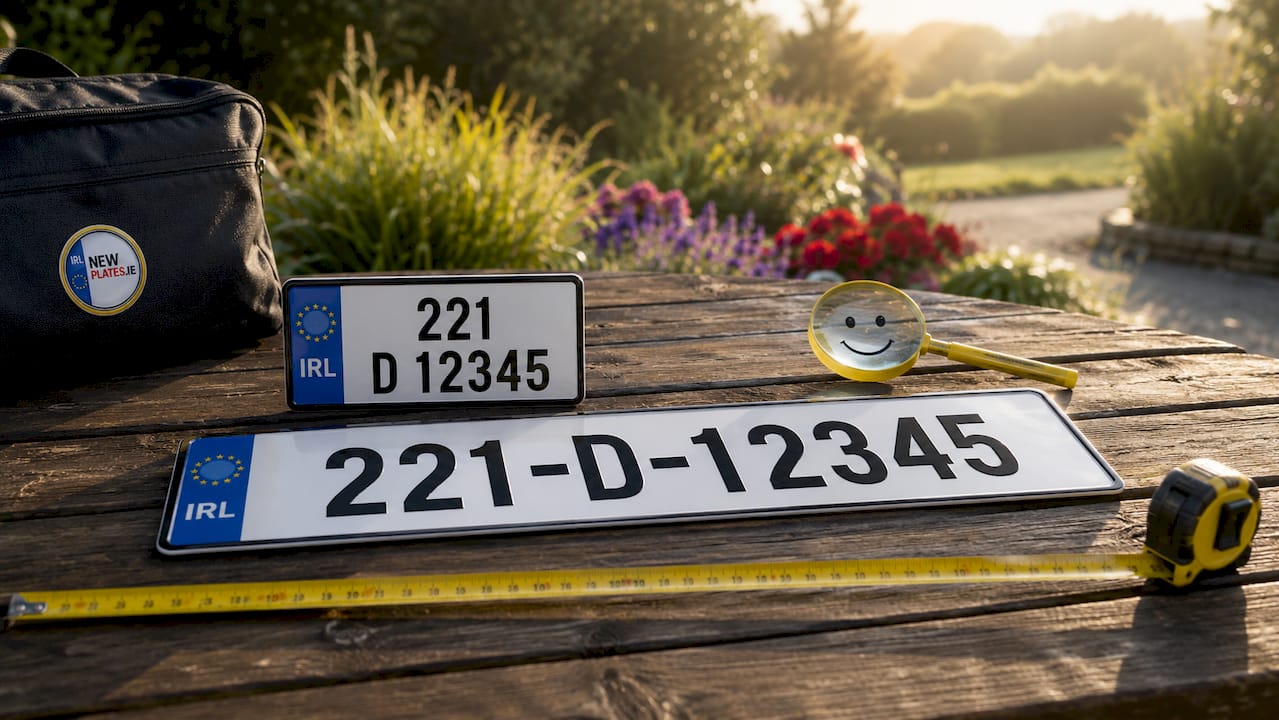
The font is not optional either. Only the Charles Wright typeface or the Irish government-specified equivalent is legally permitted on road plates. This applies to both bikes and cars, but it matters more on motorbike plates because the reduced character size leaves no room for decorative fonts that compress or distort letterforms. Any deviation from the prescribed typeface is a compliance failure.
Here is how the two plate types compare across the key specifications:
| Specification | Motorbike plate | Car plate |
|---|---|---|
| Overall dimensions | 228mm x 178mm | 520mm x 111mm |
| Character height | 64mm | 79mm |
| Layout | Two-line | Single-line |
| Number of plates required | Rear only | Front and rear |
| Background color (rear) | Reflective white | Reflective yellow |
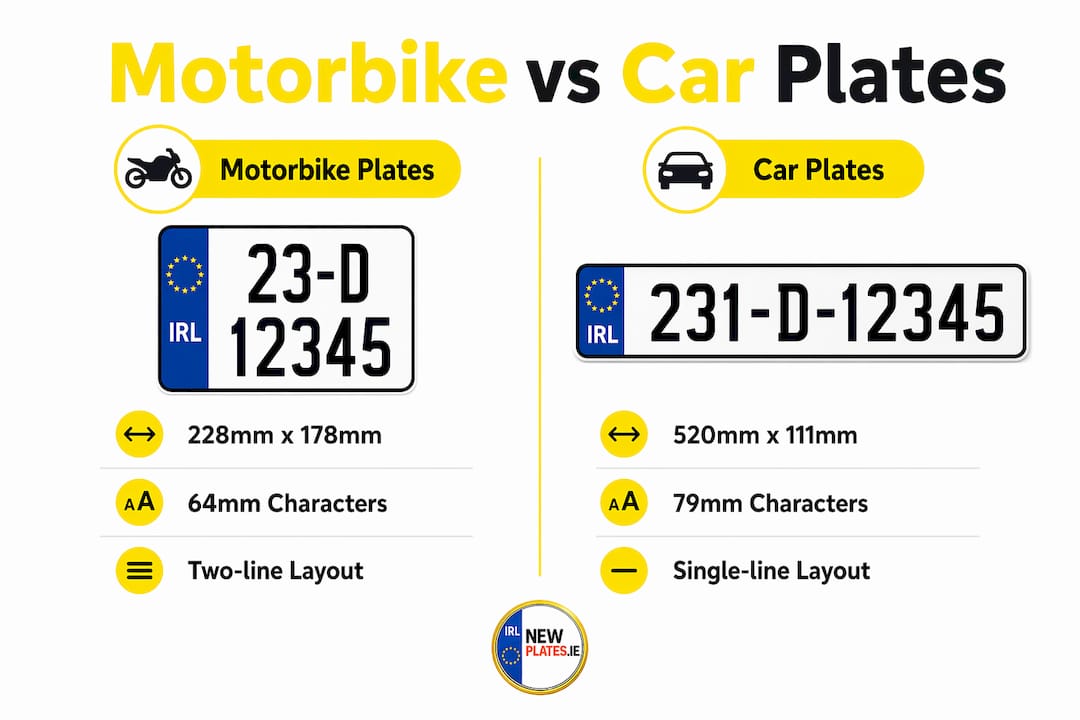
The reflective background requirement applies to both vehicle types, but the color differs at the rear. Car rear plates use a yellow reflective background, while motorcycle rear plates use white. This distinction is set in Irish law and is not a stylistic choice.
Pro Tip: If you are ordering a replacement motorbike plate, double-check that the supplier lists the plate as two-line format. A single-line motorcycle plate is not just non-standard. It is illegal under Irish regulations and can cause NCT failure.
How Irish law shapes motorbike plate requirements differently from cars
Irish vehicle registration law creates a clear split between what motorcycles and cars must display. Motorcycles require only a rear plate, while cars must carry both a front white plate and a rear yellow plate. This single-plate rule for bikes reflects the physical reality that most motorcycles have no practical front mounting point for a plate without obstructing the forks or front wheel.
Beyond the number of plates, Irish law specifies several requirements that apply to all road-legal plates, including those for motorcycles:
- The plate must display the manufacturer's name and postcode. Under BS AU 145e:2018 standards adopted in Ireland, every road-use plate must carry the supplier's details. Many show plates sold online omit this entirely, making them illegal for road use regardless of how accurate the registration number is.
- The reflective background must meet Irish standards for luminosity and durability. A faded or peeling background is a compliance failure.
- Characters must conform to the prescribed font, size, and spacing. There is essentially zero legal tolerance for deviations in character height or spacing, because automated systems depend on exact measurements for reliable recognition.
- The plate must be securely mounted and clearly visible at all times. An obscured or dirty plate is treated the same as an illegal plate by enforcement officers.
- Plates must not be altered, bent, or fitted at an angle that reduces legibility.
Non-compliance carries real consequences. Gardaí can issue fixed charge notices for illegal plates, and an NCT tester will fail a vehicle that presents a non-compliant plate. For motorcycle owners, this is particularly relevant because the single rear plate is the only identification point on the vehicle. If it fails inspection, there is no front plate to fall back on.
Pro Tip: Always ask your plate supplier for confirmation that their plates meet current Irish standards. A reputable supplier will include their name, postcode, and registration details on every road-legal plate they produce. If that information is missing, the plate is not road legal.
Why motorbike plates are built for legibility and durability
Motorcycles operate in conditions that cars rarely face at the same intensity. Vibration, weather exposure, and road debris are constant factors for a plate mounted at the rear of a bike with no surrounding bodywork to buffer the elements. A plate that degrades, cracks, or loses its characters under these conditions creates an immediate legal problem for the rider.
The design choices behind motorbike plates address these conditions directly:
- The two-line layout keeps the plate compact and reduces the surface area exposed to wind resistance and debris impact.
- The reflective white background on the rear plate maintains visibility in low light and wet conditions, which are common in Ireland.
- The prescribed character height of 64mm is the minimum needed for ANPR cameras to read the plate reliably at typical enforcement distances.
- The Charles Wright font is designed with specific stroke widths and character spacing that remain legible even when the plate is slightly dirty or partially obscured.
- Plate materials must withstand temperature variation, UV exposure, and moisture without warping or fading.
ANPR systems are the backbone of modern traffic enforcement and tolling in Ireland. These cameras capture plate images at speed and process them automatically. ANPR reliability depends on exact character height and spacing, which is why the legal tolerance for deviations is essentially zero. A plate that looks fine to the human eye but uses slightly compressed characters or non-standard spacing can generate misreads, missed tolls, or enforcement errors.
"Strict visibility and placement requirements for plates ensure law enforcement efficacy and tolling accuracy." — Irish number plate legalities
For motorcycle riders, this means the plate is doing more work per square centimeter than a car plate. Every character needs to be correct, every spacing needs to be exact, and the plate needs to stay that way through rain, motorway speeds, and the occasional pothole.
How customization options differ for motorbike versus car plates
Custom plates for motorcycles follow the same legal framework as standard plates. The registration number, font, character size, layout, and background color are all fixed by law. What you can customize is the finish and material, within limits. Options like 3D gel plates and 4D acrylic plates are available for motorcycles, but the visual enhancement cannot compromise the plate's legibility or dimensional compliance. A raised character finish that meets all size and spacing requirements is legal. A plate with stylized fonts or colored characters is not.
The distinction between road-legal plates and show plates is where many riders run into trouble. Show plates are decorative items designed for display, photography, or off-road use. They are not legal for road use, and misuse of show plates can lead to legal penalties despite their aesthetic appeal. The problem is that many show plates look convincing. They carry a registration number, they are mounted on the bike, and they appear normal at a glance. But if they lack the supplier's name and postcode, use the wrong font, or have incorrect character dimensions, they are non-compliant.
Here is a practical comparison of legal versus decorative plates for motorcycles and cars:
| Feature | Road-legal plate | Show plate / decorative plate |
|---|---|---|
| Supplier name and postcode | Required by law | Often absent |
| Prescribed font (Charles Wright) | Mandatory | Frequently non-standard |
| Correct character dimensions | Enforced | Not guaranteed |
| Reflective background | Required | May be non-reflective |
| Legal for road use | Yes | No |
| NCT compliant | Yes | No |
The cost difference between a compliant plate and a show plate is often minimal. A standard road-legal motorcycle plate from a certified Irish supplier starts at a very accessible price point. The risk of buying a non-compliant plate to save a few euros is simply not worth it when the alternative is a fixed charge notice or an NCT failure.
Pro Tip: When fitting a new plate to your motorcycle, use a proper fitting kit to mount it securely and at the correct angle. A plate that vibrates loose or tilts at an angle is a compliance issue, not just a cosmetic one.
If you are transporting your motorcycle, keep in mind that plate visibility during transport is also a legal consideration. The plate must remain readable even when the bike is loaded onto a trailer or van.
Key takeaways
Motorbike plates differ from car plates in Ireland because size constraints, single-plate requirements, and ANPR legibility standards demand a completely separate regulatory framework for motorcycles.
| Point | Details |
|---|---|
| Different dimensions | Motorcycle plates are 228mm x 178mm; car plates are 520mm x 111mm. |
| Two-line layout required | Single-line motorcycle plates are illegal in Ireland and cause NCT failure. |
| Rear plate only for bikes | Cars need front and rear plates; motorcycles require only a rear plate. |
| Supplier details mandatory | Road-legal plates must display the manufacturer's name and postcode by law. |
| Show plates are not road legal | Decorative plates without correct font, dimensions, or supplier details are non-compliant. |
What riders often get wrong about plate rules
From what we have seen, the most common mistake motorcycle owners make is assuming that any plate carrying their correct registration number is legal. It is not. The registration number is just one element. The font, the character height, the layout, the background, and the supplier details all have to be right simultaneously. Getting four out of five correct still means a non-compliant plate.
The second mistake is buying plates from suppliers who do not specialize in Irish road-legal plates. A plate that meets standards elsewhere may not meet Irish requirements. The character heights differ, the background color rules differ, and the supplier information requirements are specific to Irish law. Ordering from a supplier who understands the Irish regulatory framework is not just convenient. It is the only way to guarantee compliance.
There is also a tendency among enthusiasts to treat the plate as a styling opportunity rather than a legal document. That instinct is understandable. A well-finished 3D gel plate does look better than a flat standard plate. But the styling has to happen within the rules. The good news is that compliant plates can still look excellent. The constraint is not on aesthetics. It is on the specific dimensions and font that make the plate readable and legal.
Plate regulations in Ireland are not static. Staying informed about current standards, particularly as ANPR technology evolves and enforcement becomes more automated, is genuinely useful for any vehicle owner. A plate that was compliant five years ago may not meet 2026 standards if the rules have been updated.
— Patrick
Get road-legal motorbike and car plates from Newplates
If you want a plate that looks great and passes every inspection, Newplates has you covered for both motorcycles and cars.
Newplates offers road-legal 3D gel plates and standard NCT-compliant plates built to current Irish specifications, including the correct two-line format for motorcycles, prescribed character heights, and mandatory supplier details on every plate. Whether you want a clean standard plate or a premium 3D finish, every option from Newplates meets the legal requirements that matter at the NCT and on the road. Prices start from €15.99, and ordering is straightforward. Visit Newplates.ie to configure your plate and get it delivered directly to your door.
FAQ
Why do motorbike plates use a two-line layout?
The two-line layout is a legal requirement in Ireland because it allows characters to remain at the minimum required height of 64mm within the motorcycle's smaller plate dimensions. A single-line format on a motorcycle-sized plate would require characters too small to meet legibility standards.
Do motorcycles need a front plate in Ireland?
No. Irish law requires motorcycles to display only a rear plate with a reflective white background. Cars must carry both a front white plate and a rear yellow plate.
What makes a motorcycle plate non-compliant?
A motorcycle plate is non-compliant if it uses the wrong font, incorrect character height or spacing, a non-reflective background, or if it omits the supplier's name and postcode. Non-compliant plates can result in fixed charge notices and NCT failure.
Are 3D gel plates legal on motorcycles in Ireland?
Yes, provided they meet all dimensional and legibility requirements. The visual finish can be enhanced with 3D gel characters, but the character height, spacing, font, and background must still conform to Irish standards.
Can I use a show plate on my motorcycle on public roads?
No. Show plates are designed for display or off-road use only. They typically lack the supplier's name and postcode, use non-standard fonts, and do not meet the reflective background requirements for road use in Ireland.