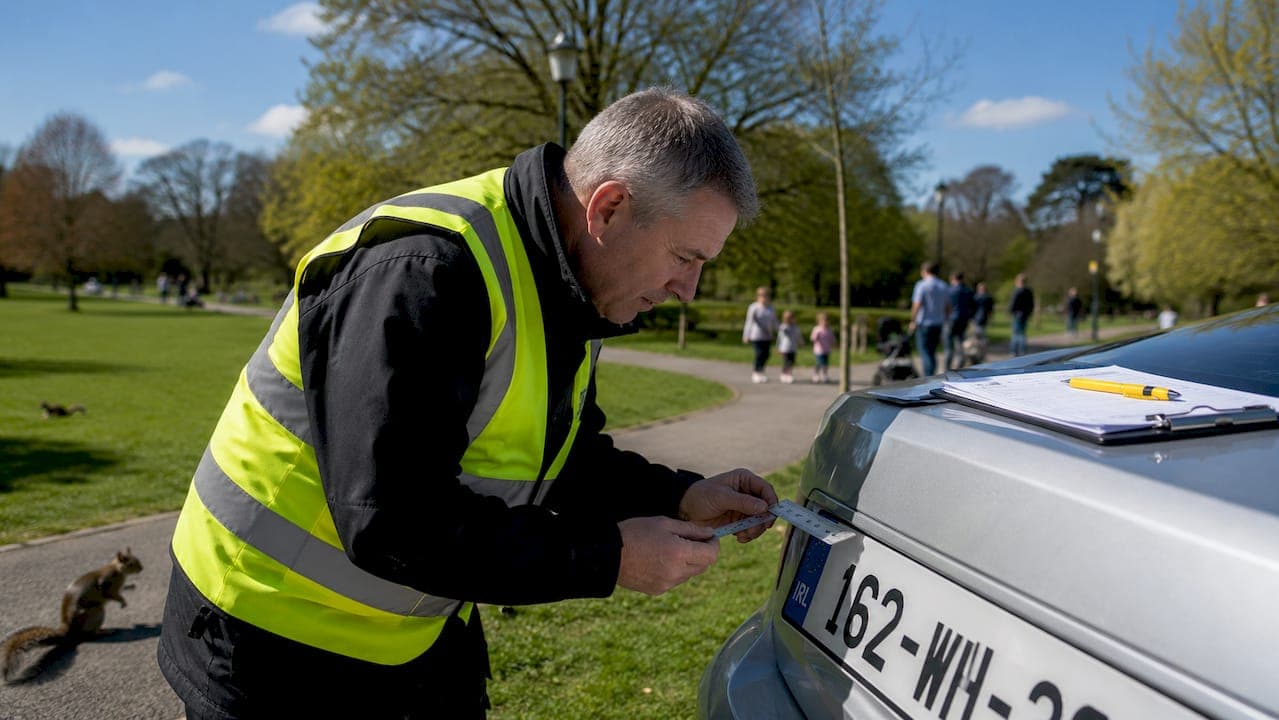
Number plate fonts are specially designed typefaces governed by exact legal standards to ensure maximum readability and enforceability on Irish roads. Understanding how number plate fonts work means knowing that every character dimension, spacing measurement, and color choice is prescribed by regulation, not left to personal taste. In Ireland, plates must conform to the Charles Wright 2001 typeface, a sans-serif font built for both human and automated recognition. Get the font wrong and you are not just looking at an ugly plate. You are looking at a failed NCT, a fine, and a very awkward conversation with the gardaí.
How number plate fonts work: the Charles Wright standard
The Charles Wright 2001 font is the mandatory typeface for all road-legal number plates in Ireland, aligned with BS AU 145e standards. It is a modern adaptation of a 1935 typeface, updated specifically to meet the demands of modern Automatic Number Plate Recognition (ANPR) systems. The font uses solid black, sans-serif characters printed on a reflective white background at the front and a reflective yellow background at the rear.
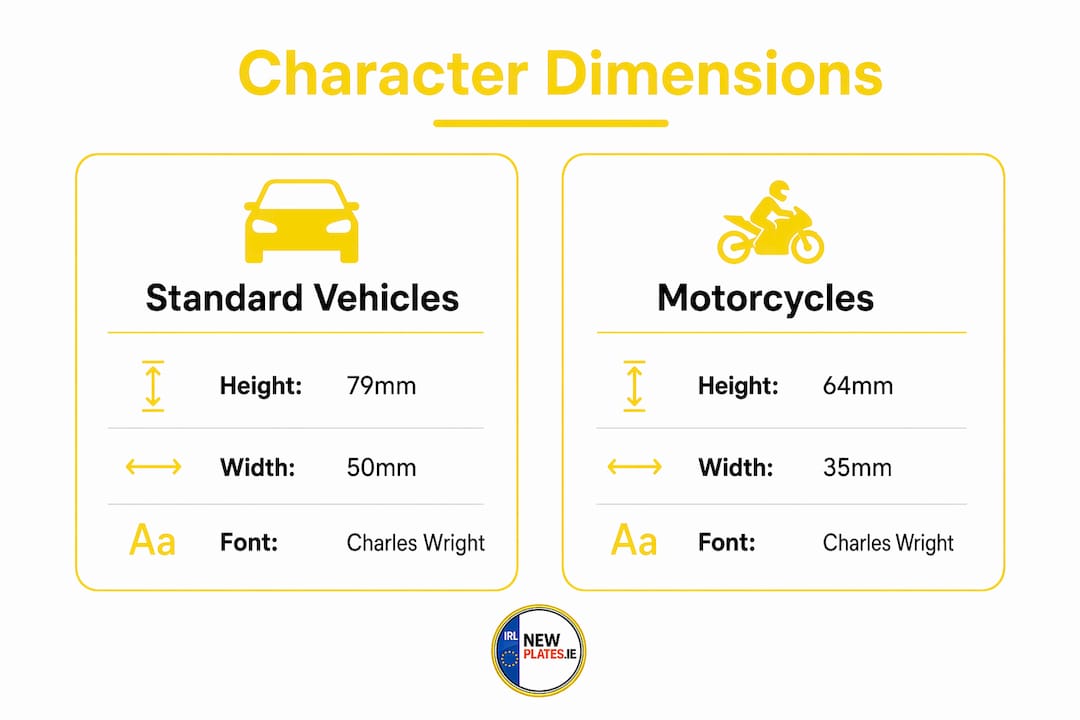
Every character dimension is fixed. The exact character height is 79mm, the width is 50mm (except for the characters "1" and "I"), the stroke thickness is 14mm, the gap between characters is 11mm, and the gap between character groups is 33mm. These are not suggestions. They are the legal minimum and maximum simultaneously.
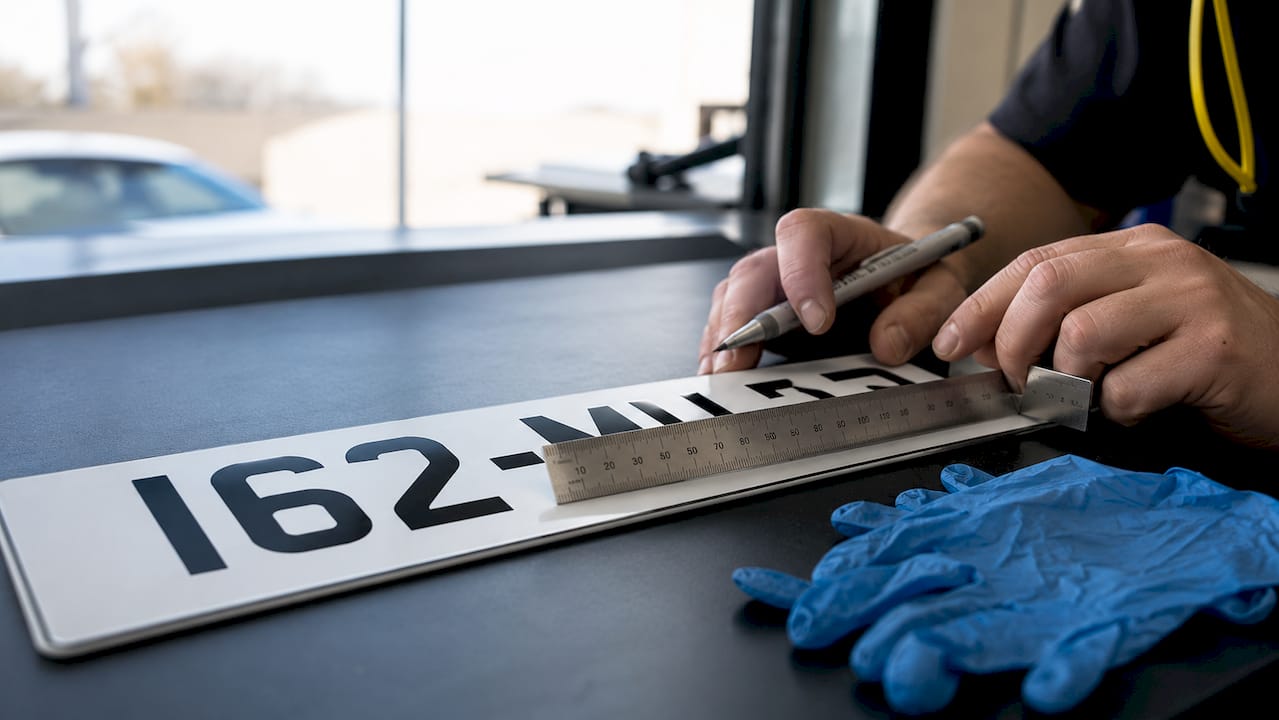
The table below summarizes the key measurements:
| Measurement | Standard vehicles | Motorcycles |
|---|---|---|
| Character height | 79mm | 64mm |
| Character width | 50mm | 44mm |
| Stroke thickness | 14mm | 10mm |
| Gap between characters | 11mm | 11mm |
| Gap between groups | 33mm | 33mm |
No modification to these dimensions is permitted on a road-legal plate. Italic characters, decorative serifs, condensed widths, and stretched heights all violate the standard. The font must appear exactly as specified, every single time.
How do number plate fonts support ANPR and law enforcement?
ANPR cameras read plates by analyzing character shapes, widths, and the spaces between them. The Charles Wright font was designed for ANPR readability, with high contrast and consistent stroke widths that perform reliably across rain, low light, and high-speed capture. That design decision has real consequences for how plates get read on Irish roads every day.
One of the font's most interesting quirks is intentional. The characters "O" and "0" (zero) are visually identical in Charles Wright. So are "I" and "1." This was a deliberate choice. ANPR systems rely on character context within the full registration string to distinguish between them, rather than trying to read each character in isolation. It reduces misreads significantly.
Uniform spacing between characters and groups is hardcoded into ANPR algorithms. Even minor deviations cause recognition errors that lead directly to enforcement failures and missed detections.
The practical result is clear. A plate with altered spacing, even by a few millimeters, can fail to register on a speed camera or toll system. That failure does not protect the driver. It creates a paper trail of unresolved queries that eventually catches up with the vehicle owner.
Key ways the font supports law enforcement:
- Fixed character widths allow OCR software to segment each character accurately.
- High-contrast black on reflective backgrounds improves camera capture in poor weather.
- Standardized spacing prevents drivers from creating misleading character groupings.
- Consistent stroke thickness reduces false positives from shadows or dirt on the plate.
What design choices are allowed without violating Irish regulations?
Most drivers assume that any personalization beyond the registration number itself is illegal. That assumption is wrong, and it stops a lot of people from getting a plate they would actually enjoy. 3D gel and 4D laser-cut characters are both permitted, provided the underlying font dimensions and character shapes remain unchanged.
What the law cares about is the geometry of the characters, not the texture or finish. A 4D plate with raised acrylic letters is road-legal as long as every character still measures 79mm tall, 50mm wide, and uses the Charles Wright letterform. The dimensional effect is purely cosmetic from a regulatory standpoint.
Prohibited modifications include:
- Italic or slanted characters of any kind.
- Script or decorative fonts that resemble Charles Wright but deviate from it.
- Gradient, two-tone, or reflective color effects on the characters themselves.
- Altered spacing between characters or groups to spell out words or names.
- Any background pattern, image, or color other than the prescribed reflective white or yellow.
The danger of "lookalike" fonts deserves special attention. Several unofficial typefaces circulate online that appear similar to Charles Wright at a glance. They fail the legal standard because their stroke widths, character proportions, or spacing do not match the specification exactly. A plate printed with a lookalike font looks fine to the human eye but fails ANPR reads and NCT inspections.
Pro Tip: Always buy from a registered plate supplier who can confirm their plates carry the BS AU 145e mark. That mark is your guarantee that the font, dimensions, and materials all meet the legal standard. Buying cheap plates from unverified sources is asking to be pulled over.
Attempts to alter spacing to create personalized words are not just a design violation. Spacing alterations are treated as criminal offenses under Irish vehicle registration regulations. The line between personalization and fraud is drawn at the point where the registration number becomes misleading.
Why does strict font regulation matter for road safety in Ireland?
Font regulation protects more than just camera systems. Uniform, legible plates are the foundation of vehicle identity on public roads. When every plate uses the same typeface and dimensions, witnesses, gardaí, and automated systems can all read a registration accurately under pressure.
Non-compliance carries real penalties. Fines can reach up to £1,000 for illegal plates, and a non-compliant plate will cause a vehicle to fail its NCT. Plates must also be produced by authorized suppliers, display the manufacturer's postcode, and carry the BS AU 145e mark to be considered valid.
The numbered list below covers the main legal risks of using a non-compliant plate:
- NCT failure on the grounds of an illegal plate, requiring replacement before the vehicle can be certified.
- Fines issued by gardaí for displaying a plate that does not meet the legal standard.
- ANPR misreads that create unresolved toll or speed camera records linked to your vehicle.
- Plate cloning vulnerability increases when non-standard fonts make it harder to distinguish genuine plates from fraudulent copies.
- Criminal liability if spacing or font alterations are deemed an attempt to obscure the vehicle's identity.
Uniform fonts also reduce vehicle identity fraud. When every plate uses Charles Wright with fixed dimensions, a cloned plate using a slightly different font becomes detectable. That is a security benefit that most drivers never think about, but it matters every time a stolen vehicle is tracked.
How do font standards vary for motorcycles and special cases in Ireland?
Motorcycles use a smaller character set because their plates are physically smaller. Motorcycle character height is 64mm, width is 44mm, and stroke thickness is 10mm. The spacing rules remain the same as standard vehicles. Newplates offers road-legal motorbike plates that meet these exact specifications for Irish registration.
Key points for special vehicle categories:
- Motorcycles must display a rear plate only, using the reduced character dimensions above.
- Trailers must carry a rear plate that matches the font, color, and material standards of the towing vehicle.
- Historic vehicles may qualify for age-related registration marks, but the plate itself must still use a legible, compliant format.
- Show plates and display plates are not road-legal and must never be fitted to a vehicle used on public roads.
Historic vehicle owners sometimes assume their vehicle's age exempts them from plate standards entirely. It does not. The registration mark may differ from a modern format, but the plate displaying it must still be readable and produced to an acceptable standard. Fitting a decorative vintage-style plate to a vehicle you actually drive is a compliance risk, however charming it looks on a sunny afternoon.
Key Takeaways
Number plate fonts in Ireland are legally prescribed typefaces with exact dimensions, and any deviation from the Charles Wright 2001 standard risks NCT failure, fines, and ANPR errors.
| Point | Details |
|---|---|
| Charles Wright is mandatory | All road-legal Irish plates must use this font with exact 79mm height and 50mm width. |
| ANPR depends on fixed spacing | Even millimeter-level spacing changes cause recognition errors and enforcement failures. |
| 3D and 4D effects are allowed | Textured finishes are legal as long as the underlying font dimensions stay unchanged. |
| Spacing alterations are criminal | Altering character spacing to form words is a criminal offense under Irish regulations. |
| Motorcycles use smaller dimensions | Motorcycle plates require 64mm character height and 44mm width under Irish law. |
Patrick's take on what most drivers get wrong about plate fonts
Most people treat number plate fonts as a purely cosmetic detail. They are not. The font is the functional core of the plate. Every dimension exists because a system somewhere, whether a camera, an inspector, or a garda, depends on it being exactly right.
The misconception I see most often is that 3D and 4D plates are somehow illegal or borderline. They are not, provided you buy from a registered supplier who uses the correct font and dimensions. The problem is not the finish. The problem is the flood of cheap plates sold online by unregistered suppliers who use lookalike fonts that fail on inspection. Buyers do not find out until their NCT.
The other thing worth saying is that the Charles Wright font is genuinely well-designed for its purpose. It is not bureaucratic box-ticking. The intentional similarity between "O" and "0" forces ANPR systems to read context, which is actually more accurate than trying to distinguish them visually. That is clever engineering from 1935, updated for a world of high-speed cameras.
If you want to personalize your plate, do it through a registered supplier, check for the BS AU 145e mark, and stick to finishes rather than font alterations. You get a plate that looks great and passes every inspection. That is the right outcome for everyone.
— Patrick
Newplates and legally compliant plate options for Irish drivers
Newplates produces NCT-compliant number plates that meet Irish registration standards, with prices starting from €15.99. Every plate uses the correct Charles Wright font with exact character dimensions, reflective backgrounds, and the required compliance markings.
For drivers who want something more distinctive, Newplates also offers road-legal 4D plates with raised acrylic characters that comply fully with Irish regulations. The font and dimensions stay exactly as required. The finish is what changes. You can also explore the full range of custom plate options to find a style that suits your vehicle without compromising on compliance.
FAQ
What font do Irish number plates use?
Irish road-legal number plates use the Charles Wright 2001 font, aligned with BS AU 145e standards. This sans-serif typeface is mandatory for all registered vehicles in Ireland.
Are 3D and 4D number plates legal in Ireland?
Yes. 3D gel and 4D laser-cut plates are legal in Ireland as long as the underlying Charles Wright font dimensions remain unchanged. The finish can be textured or raised; the character geometry cannot be altered.
What happens if my number plate font is wrong?
A non-compliant font causes NCT failure and can result in fines under Irish vehicle registration regulations. ANPR systems may also fail to read the plate accurately, creating enforcement complications.
Can I change the spacing on my plate to spell a word?
No. Altering character spacing to create words or names is a criminal offense under Irish regulations. Fixed spacing is also critical for ANPR accuracy and cannot be modified on a road-legal plate.
Do motorcycles need a different font size on their plates?
Motorcycles use smaller character dimensions: 64mm height, 44mm width, and 10mm stroke thickness. The font itself remains Charles Wright, and the spacing rules are the same as for standard vehicles.