
Road legal number plates are official vehicle identifiers that must meet precise regulatory standards set by the Irish Vehicle Registration Authority to be lawfully displayed on public roads. Getting this wrong is not just a cosmetic issue. Non-compliant plates can result in fines, failed NCT inspections, and unwanted attention from the gardaí. Whether you drive a car or a motorcycle, understanding what makes a plate genuinely legal protects you every time you pull out of the driveway.
What are the official standards for road legal number plates in Ireland?
Irish road legal registration plates must conform to a specific set of technical requirements covering font, dimensions, color, reflectivity, and supplier markings. These are not suggestions. Every element is mandatory, and a plate missing even one requirement fails compliance.
Font and character dimensions
The only permitted font for Irish road legal plates is Charles Wright 2001. This font has exact legal dimensions that every plate must follow: character height of 79mm, character width of 50mm (with some exceptions for narrow characters), stroke width of 14mm, and spacing between characters of 11mm. These measurements exist so that ANPR cameras and human observers can read plates accurately at speed. Any deviation from these figures makes the plate non-compliant, regardless of how close it looks to the real thing.
Color and reflectivity requirements
Irish plates follow a straightforward color rule. The front plate must have a white reflective background, and the rear plate must have a yellow reflective background. The reflective material is not optional. It ensures plates are visible at night and in poor weather conditions, which matters both for road safety and for law enforcement cameras. A plate printed on non-reflective material fails this standard completely.
Material and durability standards
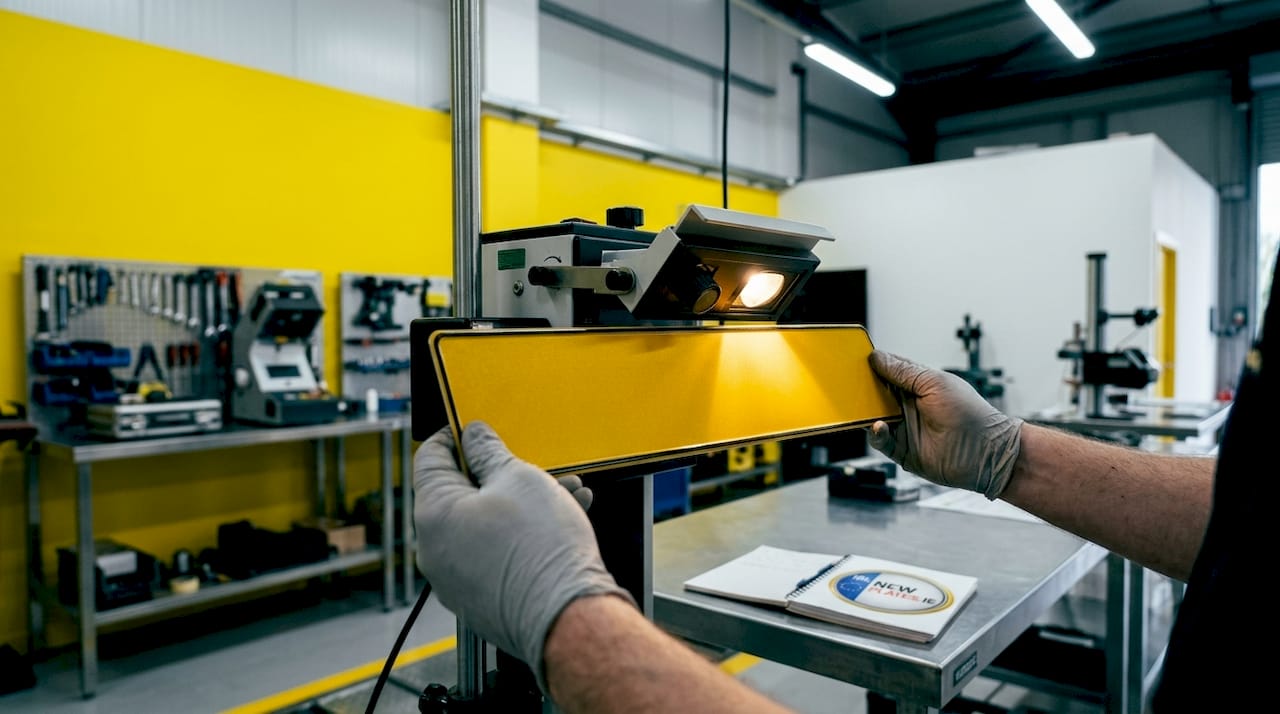
Plates must meet the BS AU 145e standard, which covers reflectivity and durability testing after exposure to harsh weather and UV light. This certification was updated in 2021, and plates without the BS AU 145e marking are non-compliant regardless of how they look. Think of it as the quality hallmark that proves the plate will still be readable after a wet Irish winter.
Mandatory supplier markings
Every road legal plate must display the supplier's name and postcode on the plate itself. This is a traceability requirement. Failure to display supplier details is grounds for NCT failure and fines. The BS AU 145e certification mark must also appear on the plate.
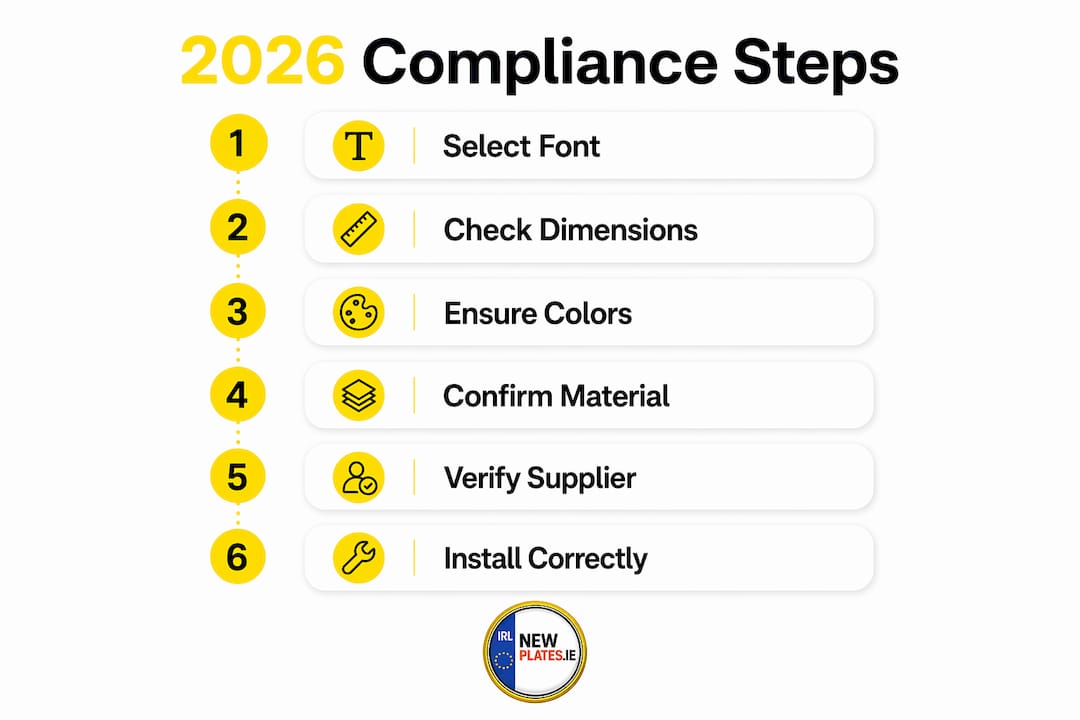
Here is a quick reference for the core specifications:
| Specification | Requirement |
|---|---|
| Font | Charles Wright 2001 only |
| Character height | 79mm |
| Character width | 50mm (standard) |
| Stroke width | 14mm |
| Character spacing | 11mm |
| Front background | White reflective |
| Rear background | Yellow reflective |
| Certification | BS AU 145e marked |
| Supplier details | Name and postcode required |
How do you identify and avoid illegal number plates?
The most common mistake Irish drivers make is confusing show plates with road legal plates. Show plates are decorative items made for display at car shows, private driveways, or as novelty gifts. They are not manufactured to meet reflectivity or font standards, and displaying them on public roads is a straightforward legal violation. The distinction matters because some sellers market show plates with vague language that implies road legality without actually guaranteeing it.
Common illegal features to watch out for include:
- Non-reflective backgrounds: If the plate does not have a clearly reflective surface, it fails immediately.
- Incorrect fonts: Stylized, italic, or decorative fonts are illegal. Only Charles Wright 2001 is permitted.
- Wrong spacing: Characters that are too close together or too far apart violate the 11mm spacing rule.
- Tinted covers: Any cover that reduces plate visibility is illegal, including smoked or tinted plastic covers.
- Decorative frames: Frames that obscure any part of the registration, including the county identifier or supplier details, are non-compliant.
- Missing supplier information: No name, no postcode, no compliance.
The legal consequences of running a non-compliant plate range from a fine to a failed NCT. Gardaí can stop you on the spot if a plate looks suspicious, and ANPR systems may flag vehicles with plates that interfere with camera recognition. Enforcement has tightened since 2021, with increased focus on plate visibility and identifying marks.
Pro Tip: Before buying any plate online, check that the supplier explicitly states BS AU 145e compliance and requires proof of vehicle entitlement. If a seller does not ask for documentation, that is a red flag.
What is the process for getting road legal number plates legally in Ireland?
Obtaining replacement or personalized legal license plates in Ireland follows a clear process. Skipping any step risks ending up with a plate that looks fine but fails an NCT check.
-
Gather your proof of entitlement. You need your vehicle's registration document (the equivalent of a logbook) to prove you are entitled to display the registration number. Reputable suppliers will not produce a plate without this. Legal plate suppliers require documentation upload before production, and online submission typically takes less than 2 minutes to verify.
-
Choose a registered, compliant supplier. Not all sellers claiming compliance actually verify entitlement or use approved materials. Look for suppliers who explicitly state BS AU 145e certification and display their own supplier details on finished plates. Newplates is one such registered supplier operating in Ireland.
-
Select your plate style within legal limits. You can choose from standard flat plates, 3D gel plates, or 4D legal plates, provided the style meets all font, spacing, and reflectivity requirements. The raised lettering on 3D and 4D plates is legal as long as the underlying specifications are met.
-
Submit your documentation and confirm your order. Upload your proof of entitlement through the supplier's online system. A reputable supplier will verify this before manufacturing begins.
-
Inspect the finished plate before installation. Check that the Charles Wright 2001 font is used, the background colors are correct, the BS AU 145e mark is present, and the supplier's name and postcode appear on the plate. If anything is missing, do not install it.
-
Keep a record of your purchase. Store your order confirmation and proof of entitlement. If you are ever stopped by gardaí or face an NCT query, this documentation supports your case.
How do you install and maintain plates to stay compliant?
Correct installation is the final step in keeping your vehicle legal. A perfectly manufactured plate becomes a liability if it is mounted incorrectly or allowed to deteriorate.
Key installation and maintenance rules include:
- Mount plates vertically and securely. Plates must be clearly visible from the front and rear of the vehicle. A plate that droops, tilts, or vibrates loose is asking for a roadside stop.
- Never use tinted covers. Tinted or smoked covers that obscure plate details are illegal. Visibility of the full registration must not be blocked by any cover or frame.
- Avoid decorative frames that cover any text. Frames are fine if they sit entirely outside the plate's printed area. The moment a frame covers a character, a county code, or supplier details, the plate is non-compliant.
- Clean plates regularly. Dirt, mud, and road grime can obscure characters enough to trigger an ANPR flag or a garda stop. A quick wipe-down is all it takes.
- Replace damaged plates promptly. Cracked, faded, or peeling plates lose their reflectivity and legibility. A plate that was compliant when new can become non-compliant through wear.
For motorcycle owners, the legal installation requirements include specific rules on plate angle and positioning that differ slightly from car plates. Getting this right matters because motorcycle plates are inspected closely during NCT checks.
Pro Tip: Take a photo of your newly installed plates from 10 meters away, both front and rear. If you cannot read the full registration clearly in the photo, neither can an ANPR camera.
Key Takeaways
Road legal number plates in Ireland must meet every technical specification, from the Charles Wright 2001 font to BS AU 145e certification, to pass NCT inspection and avoid fines.
| Point | Details |
|---|---|
| Font is non-negotiable | Only Charles Wright 2001 with exact dimensions is permitted on Irish roads. |
| Reflectivity is mandatory | White front and yellow rear reflective backgrounds are required by law. |
| BS AU 145e certification matters | Plates without this marking fail compliance regardless of appearance. |
| Supplier details must appear on the plate | Missing name or postcode is grounds for NCT failure and fines. |
| Installation affects legality | Tinted covers, obscuring frames, and poor mounting can make a legal plate illegal. |
Why compliance is more than just ticking a box
I have seen a lot of drivers fall into the same trap. They order a plate that looks exactly right, it arrives quickly, the price was good, and they bolt it on without a second thought. Then the NCT comes around and the plate fails because the supplier never asked for proof of entitlement, the BS AU 145e mark is missing, or the font is a close imitation rather than the genuine Charles Wright 2001.
The thing that surprises most people is how much ANPR technology depends on plate compliance. Custom fonts, non-standard spacing, and non-reflective surfaces all interfere with camera recognition. Since 2021, enforcement has become noticeably stricter on this front. A plate that would have passed a casual inspection five years ago now gets flagged regularly.
My honest advice is to treat your plate purchase the same way you treat your insurance. You would not buy a policy from a seller who did not ask for your details. The same logic applies here. If a supplier does not ask for your vehicle registration document before making your plate, walk away. Reputable suppliers verify entitlement because the law requires it, and because it protects you.
The history of Irish number plates shows that these regulations have evolved precisely because vague standards created enforcement problems. The current rules exist for good reasons, and working with them rather than around them is always the smarter call.
— Patrick
Newplates has your compliant plates covered
Getting a genuinely road legal plate should not feel like navigating a legal exam. Newplates makes the process straightforward for Irish drivers, whether you drive a car or a motorcycle.
Newplates produces NCT compliant standard plates as well as premium 3D gel Irish number plates and 4D legal plates, all manufactured to meet Irish road legal standards including BS AU 145e certification. Every order requires proof of vehicle entitlement before production begins. Prices start from €15.99, and the online ordering process is fast and straightforward. If you want a plate that passes the NCT and keeps the gardaí happy, Newplates is the place to start.
FAQ
What font is required for road legal plates in Ireland?
The only permitted font is Charles Wright 2001, with a character height of 79mm, width of 50mm, and 11mm spacing between characters. Any other font makes the plate non-compliant.
Are 3D and 4D plates road legal in Ireland?
Yes, 3D and 4D plates are road legal in Ireland provided they use the correct font, reflective backgrounds, and carry the BS AU 145e certification mark. The raised lettering style itself is not the issue; the underlying specifications must still be met.
What documents do I need to order a legal plate?
You need proof of vehicle entitlement, typically your vehicle registration document. Reputable suppliers require this before manufacturing any road legal plate.
Can I use a show plate on public roads in Ireland?
No. Show plates lack the reflective materials and font compliance required by Irish law. Displaying show plates on public roads is illegal and can result in fines or a failed NCT.
What happens if my plate fails the NCT?
A non-compliant plate is grounds for NCT failure, and you will need to replace it with a fully compliant plate before your vehicle can pass. Missing supplier details, incorrect fonts, or absent BS AU 145e markings are the most common reasons for plate-related failures.