
A legal show plate is a vehicle number plate that fully complies with Irish road regulations, covering font style, character size, spacing, reflective materials, and permanent supplier markings. Show plates, by contrast, are decorative plates made for display, exhibitions, or private property use only. They do not meet Irish legal standards and cannot be used on public roads. The distinction matters because driving with a non-compliant plate in Ireland can result in fines, a failed NCT, or worse. If you love customizing your vehicle, understanding this difference is the first step to staying on the right side of the law.
What is a legal show plate under Irish regulations?
A legal show plate, in the strictest sense, is actually a contradiction in terms. The industry term is a road-legal number plate, and it refers to a plate that meets every requirement set by the National Vehicle and Driver File (NVDF) and Irish transport regulations. Show plates, by definition, do not meet these standards for font, spacing, reflectivity, or supplier markings, making them illegal on public roads.
The confusion arises because the phrase "legal show plate" gets used loosely online. What most people mean when they search for it is: "Can I get a custom-looking plate that is still road legal?" The answer is yes, but only if the plate meets every technical requirement. A plate that looks great but skips the Charles Wright 2001 font or drops the supplier details is a show plate, not a road-legal plate, regardless of what the seller calls it.
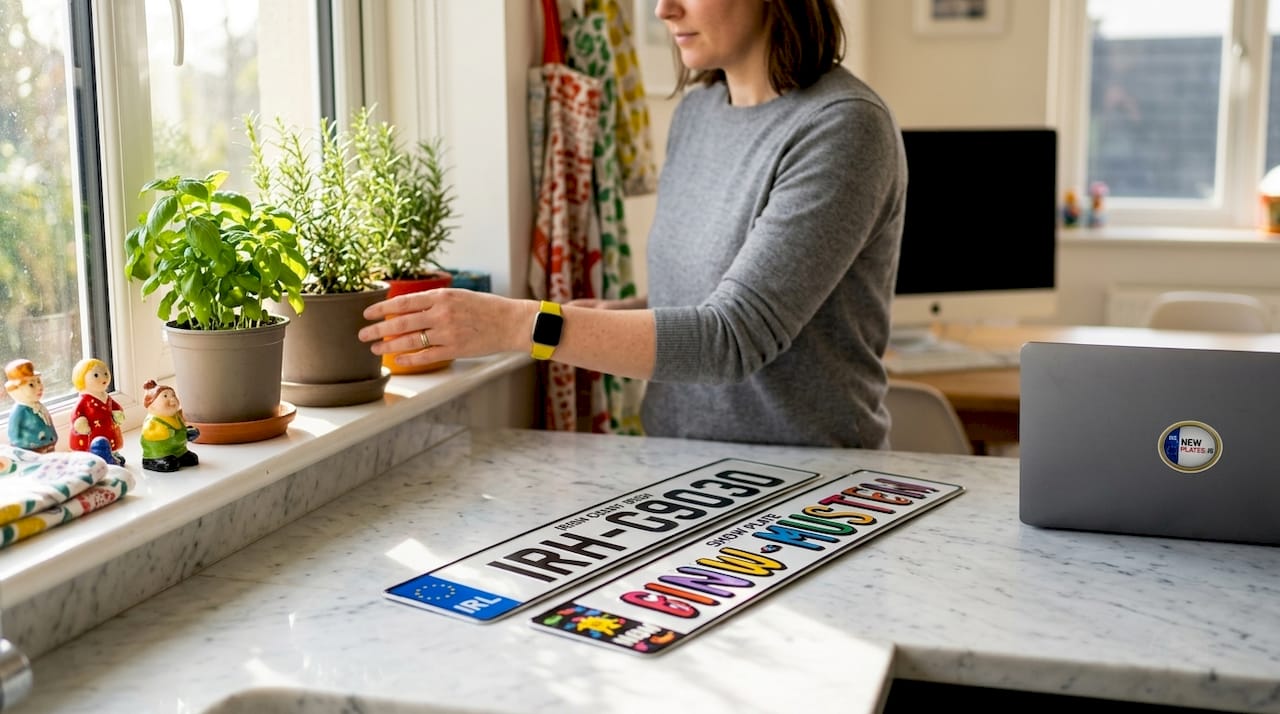
Market confusion caused by terms like "road-legal style" or "MOT-friendly show plate" misleads buyers. Legal compliance for plates on Irish roads is binary and strict. A plate either meets every requirement or it does not.
What are the legal requirements for vehicle number plates in Ireland?
Irish road-legal plates must meet a specific set of technical standards. These are not suggestions. Every requirement must be satisfied for a plate to be considered compliant under Irish law.
The core requirements include:
- Font: The Charles Wright 2001 font is mandatory. No stylized, italic, or decorative alternatives are permitted.
- Character height: Front and rear plates require specific character dimensions that meet NVDF standards.
- Reflective background: The front plate must have a white reflective background. The rear plate must have a yellow reflective background. Tints, patterns, and colored overlays are not allowed.
- Supplier markings: The plate must permanently display the supplier's name, postcode, and certification marks. These cannot be stickers added later.
- Certification: Road-legal plates require compliance with recognized certification standards, including specific character dimensions and approved materials.
Legal plate suppliers in Ireland must also verify identity and vehicle ownership before issuing plates. This means presenting proof of vehicle registration and photo ID. Show plate vendors skip this step entirely, which is one of the clearest signals that a plate is not road-legal.
Pro Tip: When ordering a plate online, check whether the supplier asks for your vehicle registration document and photo ID. If they do not, the plate they are selling is almost certainly a show plate, not a road-legal one.
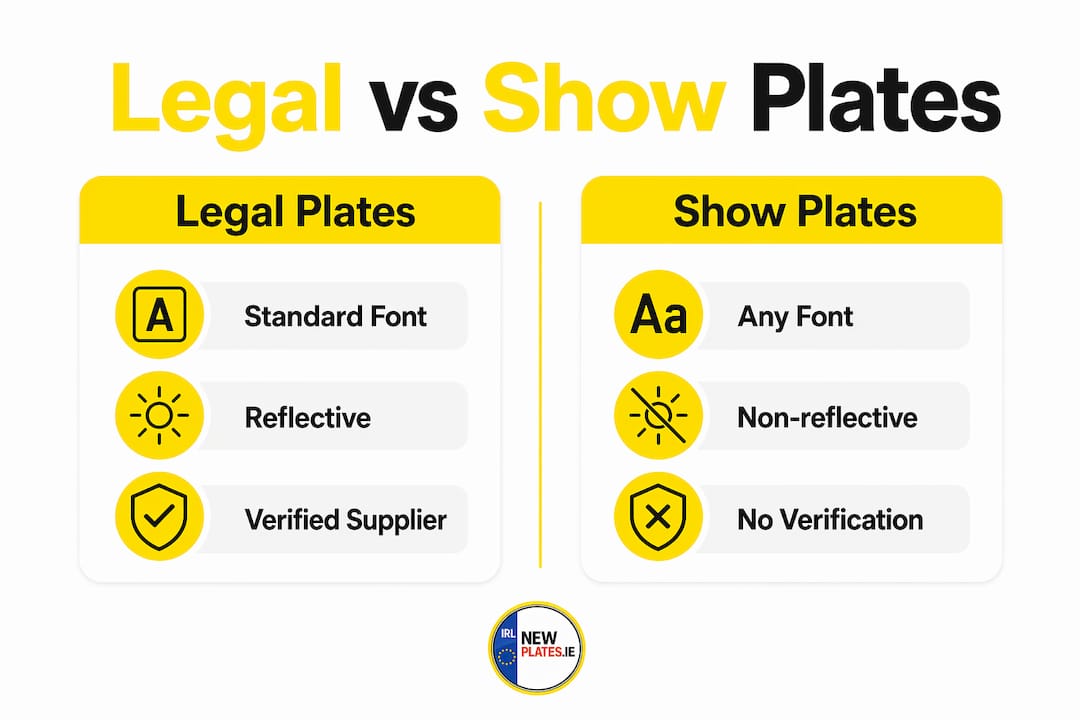
Show plates, by contrast, can use any font, any color, any spacing, and any design the buyer wants. That creative freedom is exactly what makes them appealing for car shows, private collections, and display purposes. It is also exactly what makes them illegal on public roads.
How do show plates differ from legal number plates in Ireland?
Show plates are custom-made number plates for off-road or display use only. They are not designed to comply with Irish road legal standards, and they do not. That is not a flaw in the product. It is the point. Show plates exist for aesthetics, not compliance.
Common features of show plates include custom fonts, non-standard spacing, colored backgrounds, logos, images, and the absence of supplier markings or certification details. Some show plates look almost identical to road-legal plates at a glance. Others are clearly decorative, with novelty text or graphic designs. Neither type is legal on a public road.
| Feature | Road-legal plate | Show plate |
|---|---|---|
| Font | Charles Wright 2001 only | Any font |
| Background color | White (front), yellow (rear) | Any color |
| Reflective material | Mandatory | Not required |
| Supplier markings | Permanently displayed | Usually absent |
| Identity verification | Required at purchase | Not required |
| Legal for public roads | Yes | No |
| NCT compliant | Yes | No |
Show plates are perfectly legal in the right context. Displaying one on a vehicle at a private car show, in a garage, or on a display stand involves no legal risk. The problem starts the moment that vehicle pulls onto a public road. At that point, the plate must be road-legal, full stop.
Where can you use show plates legally?
- Private property, including driveways and private land
- Indoor and outdoor car shows and exhibitions
- Display purposes such as framed plates in a garage or workshop
- Promotional or branding displays not attached to a vehicle on a public road
What are the risks of using show plates on public roads in Ireland?
Using show plates on public roads in Ireland carries real consequences. Fines can reach significant amounts, and vehicles can fail NCT inspections or face enforcement action from the Gardaí. This is not a theoretical risk. Plate compliance is checked during NCT inspections, and a non-compliant plate is an automatic failure point.
- Fines and penalties. Driving with a non-compliant plate is an offense under Irish road traffic legislation. The Gardaí have the authority to issue fines on the spot.
- NCT failure. A show plate on your vehicle during an NCT will result in a failed inspection. You will need to retest once the issue is corrected.
- ANPR problems. Show plates distort readability and reduce the ability of Automated Number Plate Recognition systems to identify vehicles reliably. This creates issues with law enforcement and camera systems.
- Insurance complications. If you are involved in an accident while displaying a non-compliant plate, your insurer may reject your claim on the grounds that the vehicle was not road-legal at the time.
- Vehicle impoundment. In serious cases, Gardaí can impound a vehicle displaying a plate that obscures or misrepresents the registration.
"There is no legal grey area for show plates on roads. Plates are either fully compliant or illegal, with no exceptions. Terms like 'MOT-friendly' or 'legal with disclaimer' show plates are simply marketing and are not legally recognized under Irish road traffic law."
One myth worth addressing directly: carrying your road-legal plates inside the vehicle while displaying show plates on the road does not satisfy Irish law. Fitted plates on public roads must always be compliant. Stowing the legal plates in the boot does not count as compliance.
Practical advice for vehicle owners on show plates and compliance
The simplest rule is this: road-legal plates go on the car when it goes on the road. Show plates go on the car when it stays off the road. Keeping those two situations separate eliminates virtually all legal risk.
Best practice for vehicle owners is to keep show plates for off-road or exhibition use only and revert to legal plates for all road use. Here is how to manage that practically:
- Store your road-legal plates safely when attending a show, and refit them before driving home.
- Never swap plates on a public road. Do it on private property.
- Keep a record of your legal plate details in case you need to verify compliance.
- Check that your supplier is registered and asks for identity verification before purchase.
- Look for permanent supplier markings on any plate you intend to use on the road.
The good news for customization enthusiasts is that you do not have to choose between style and compliance. Road-legal 3D and 4D plates can be fully compliant provided they use the Charles Wright 2001 font, correct character dimensions, approved reflective materials, and permanent supplier markings. The raised or gel characters add visual depth without breaking any rules, as long as the underlying specifications are met.
Pro Tip: When buying a 3D or 4D plate, ask the supplier specifically whether the plate meets NVDF standards and whether it includes permanent supplier identification. A reputable supplier will confirm this without hesitation.
Newplates offers road-legal 3D gel plates that meet Irish compliance standards, giving you the custom look without the legal headache. Prices start at €15.99, making compliance genuinely accessible. You can also check the Irish number plate legal standards to understand exactly what your plate needs to include before you order.
Key Takeaways
A road-legal plate in Ireland must meet every NVDF requirement for font, reflectivity, supplier markings, and character dimensions. Show plates that skip any one of these requirements are illegal on public roads, regardless of how they are marketed.
| Point | Details |
|---|---|
| Legal definition | A road-legal plate meets all NVDF standards; show plates do not and are for display only. |
| Core requirements | Charles Wright 2001 font, reflective backgrounds, correct dimensions, and permanent supplier markings are all mandatory. |
| Show plate risks | Using show plates on public roads risks NCT failure, Gardaí fines, ANPR issues, and insurance rejection. |
| No grey area | Carrying legal plates in the car while displaying show plates on the road does not satisfy Irish law. |
| Legal customization | Road-legal 3D and 4D plates are fully compliant when they meet all font, spacing, and material standards. |
Why I think the "show plate grey area" myth does more harm than good
The idea that show plates exist in some kind of legal grey area is one of the most persistent myths in the vehicle customization world. I have seen it repeated endlessly in forums, Facebook groups, and even by some plate sellers who really should know better. The reality is far simpler and far less forgiving.
Irish road traffic law does not recognize degrees of compliance. A plate either meets every requirement or it does not. The moment you drive onto a public road with a show plate fitted, you are breaking the law. Full stop. There is no partial credit for having the right registration number but the wrong font.
What frustrates me most is the way certain marketing terms muddy the water. Phrases like "road-legal style" or "NCT-friendly" attached to show plates are designed to sound reassuring without actually promising anything. Buyers read those words and assume they are covered. They are not.
The enthusiast community deserves better than that. If you love your car and you want it to look great, there are genuinely legal ways to do that. A well-made 3D or 4D plate from a registered supplier looks outstanding and keeps you fully compliant. That is the option worth pursuing. Save the show plates for the garage wall or the car show stand, where they belong and where they look fantastic.
— Patrick
Newplates has compliant custom plates worth checking out
If you want a plate that turns heads without turning on the Gardaí's lights, Newplates has you covered.
Newplates specializes in road-legal customized Irish number plates, including 4D legal plates and 3D gel options that meet all NVDF standards. Every plate includes the required supplier markings, uses approved reflective materials, and is produced by a registered manufacturer. The ordering process includes identity and vehicle verification, so you know the plate you receive is genuinely road-legal. Prices start at €15.99, and the range covers cars, motorbikes, and specialist vehicles. Browse the full selection at newplates.ie and find a plate that works on the road and at the show.
FAQ
What is the legal show plate definition in Ireland?
A road-legal number plate in Ireland is one that meets all NVDF requirements, including the Charles Wright 2001 font, reflective backgrounds, correct character dimensions, and permanent supplier markings. Show plates do not meet these standards and are not legal on public roads.
Can I use a show plate on my car for an NCT?
No. A show plate will cause an automatic NCT failure because it does not meet Irish compliance standards for font, reflectivity, or supplier markings. You must fit a fully road-legal plate before attending an NCT inspection.
Are 3D and 4D plates legal in Ireland?
3D and 4D plates can be fully road-legal if they use the Charles Wright 2001 font, correct dimensions, approved reflective materials, and permanent supplier identification. Plates that use non-standard fonts or skip supplier markings are show plates, not road-legal plates.
What happens if the Gardaí stop me with a show plate fitted?
Driving with a non-compliant plate is an offense under Irish road traffic legislation. The Gardaí can issue an on-the-spot fine, and the vehicle may be subject to further enforcement action depending on the severity of the non-compliance.
Do I need to show ID to buy a road-legal plate in Ireland?
Yes. Legal plate suppliers must verify your identity and vehicle ownership before issuing a road-legal plate. If a supplier does not ask for these documents, the plate they are selling is a show plate, not a road-legal one.