
NCT complaint number plates are registration plates that meet all Irish legal standards required to pass the National Car Test and avoid penalties from the Gardaí. Getting this wrong is more costly than most drivers realize. Under S.I. No. 318 of 1992, non-compliance can result in fines up to €5,000, plus a €60 fixed charge notice. That means a plate you bought thinking it looked great could end up costing you far more than a replacement. This guide covers the exact legal standards, the most common reasons plates cause NCT failures, and what to do if you need to raise a complaint or dispute about your test result.
What are the legal standards for NCT number plates in Ireland?
Irish number plate standards are set out under S.I. No. 318 of 1992 and enforced at every NCT inspection. The rules are specific, and ignorance of them is not a defense when the Gardaí pull you over or a tester marks your vehicle as a fail.
The core requirements are:
- Characters: Black characters on a white reflective background for the front plate; black characters on a yellow reflective background for the rear plate.
- Font: A specific sans-serif, fixed-height font is required by law. Italic fonts are illegal, and so is any font that mimics a decorative or stylized style.
- EU flag and identifier: The plate must display the EU flag alongside the letters "IRL" on the left-hand side.
- County name: The Irish-language name of the county of registration must appear on the plate.
- Spacing and layout: Characters must follow the prescribed spacing. Altering gaps between letters or numbers to create a different appearance is a legal offense.
- 3D and raised lettering: 3D gel lettering and italic fonts are prohibited on road-legal plates. They contradict the statutory font rule directly.
Many drivers mistakenly believe that 3D gel or italic fonts are a gray area. They are not. Irish law requires a specific sans-serif fixed-height font, and any deviation from that fails the standard. The NCT tester has no discretion here.
Pro Tip: Before your NCT, hold your plate at arm's length and check that every character is clearly readable, uniformly sized, and sits on a clean reflective background. If anything looks off, replace the plate before test day.
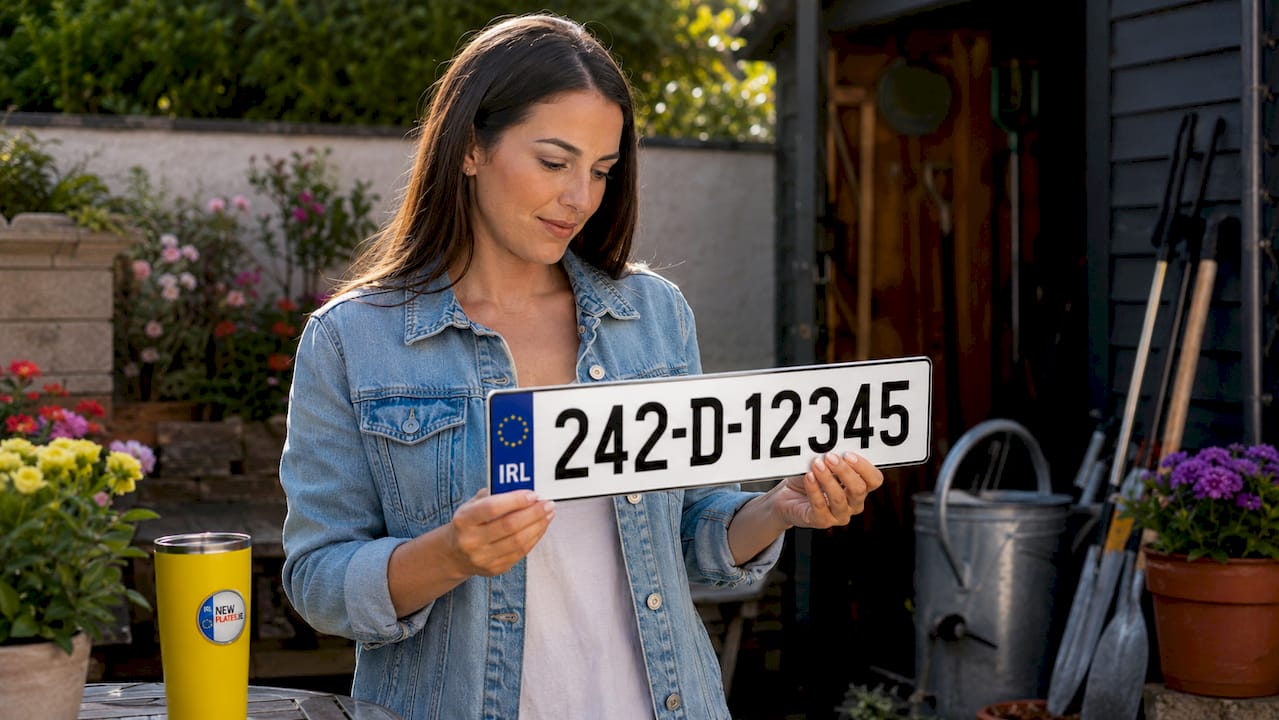
Why do number plates cause NCT failures?
Number plate issues are a surprisingly common reason vehicles fail the NCT. Some of these failures are obvious, but others catch drivers completely off guard.
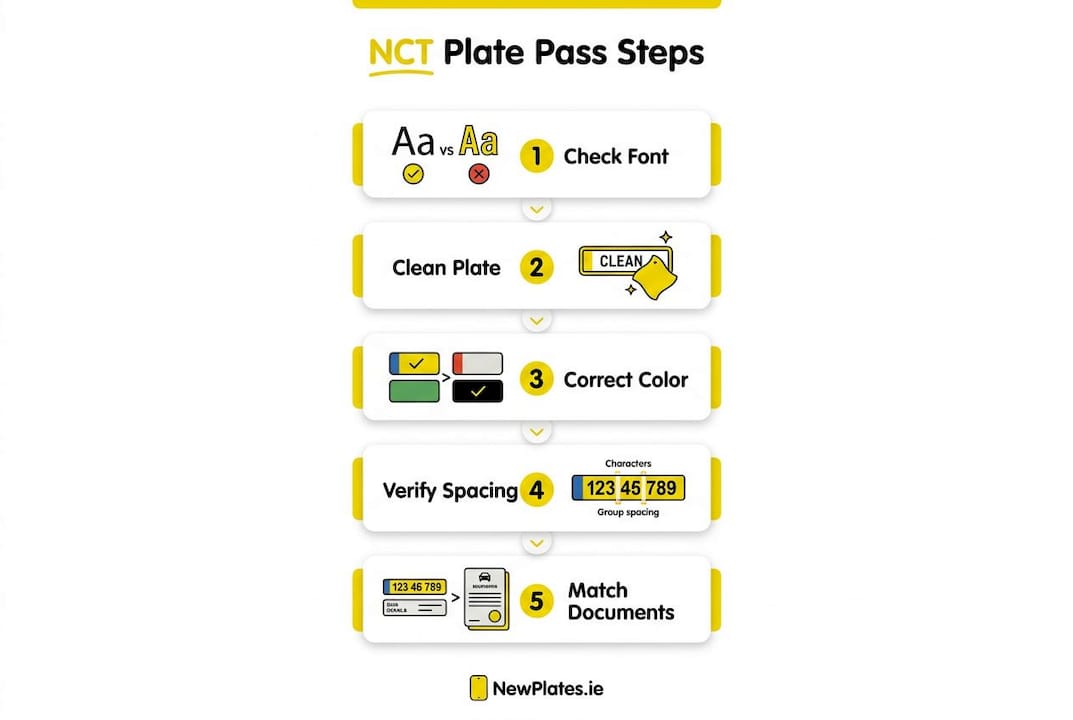
Lighting faults account for over 25% of all NCT failures, and a single non-functioning plate light causes an automatic test fail. That is a significant statistic. It means that even a perfectly legal, pristine plate will fail the test if the bulb illuminating it has blown. Replacing a plate light bulb costs as little as €2–€10 and takes about five minutes, making it one of the easiest fixes you can make before your test.
Beyond lighting, the most frequent plate-related failure causes include:
- Non-standard fonts or creative modifications: Using a stylized font, adding decorative borders, or altering character spacing all result in failure.
- Damaged or faded plates: A plate that has cracked, yellowed, or lost its reflectivity no longer meets the legal standard. Damaged plates must be replaced before the test.
- Dirt-covered or obscured plates: NCT testers have discretion to fail a vehicle if the plate is covered in mud or dirt, even if the plate itself is technically compliant. A quick wash before your test is not optional.
- Accessories blocking visibility: Bike racks, tow bars, and similar accessories that cover the rear plate cause an automatic NCT fail unless a secondary plate is attached visibly on the obstruction itself.
The pattern here is clear. Most plate-related failures are preventable with a basic pre-test check. None of them require expensive repairs.
How to make sure your plates pass the NCT
Passing the NCT on the first attempt saves you time, money, and the hassle of rebooking. For number plates specifically, the steps are straightforward.
- Source plates from a reputable supplier. No official government licensing scheme exists for plate suppliers in Ireland, which means the responsibility sits with you as the vehicle owner to verify that your plates meet all legal standards before purchase. Buy from a supplier who explicitly guarantees compliance with S.I. No. 318 of 1992.
- Budget for replacement if needed. Replacement plates cost €20–€30 for a high-quality, legally compliant set. That is a small price compared to a retest fee or a Garda fine.
- Keep plates clean and unobscured. Wash your plates before the test. Remove any accessories that block the plate from view, or fit a secondary plate to any obstruction.
- Test your plate lighting. Walk around your vehicle at night and check that the rear plate light is working. If the bulb is out, replace it before your appointment.
- Verify your plate matches your registration documents. The characters on your plate must exactly match your vehicle registration certificate. Any discrepancy is grounds for failure and can raise questions about vehicle identity.
Pro Tip: Check your road legal plates against the Vehicle Registration Certificate the week before your NCT. Mismatches between the plate and the cert are a common oversight that causes unnecessary failures.
The most overlooked step is number five. Drivers replace plates after minor damage and sometimes receive a plate with a character printed incorrectly. Always compare the new plate against your cert before fitting it.
What are the NCT complaint procedures for number plate issues?
NCT complaint procedures exist for situations where you believe your vehicle was failed incorrectly, or where you have a dispute about how your test was conducted. Number plate disputes are a legitimate reason to raise a formal complaint.
The National Car Testing Service (NCTS) handles complaints directly. If you believe your vehicle was failed unfairly on a plate-related issue, you can contact NCTS customer service through the official website at ncts.ie. Complaints can be submitted by phone or in writing, and you should keep a record of all correspondence.
Common complaint scenarios involving number plates include:
- Disputed plate failure: You believe your plate meets all legal standards but the tester marked it as non-compliant.
- Test cancellation disputes: Your test was cancelled or rescheduled without adequate notice, and you incurred costs as a result.
- Tester discretion disagreements: A tester failed your vehicle citing a dirty or obscured plate that you believe was clean and visible.
After lodging a complaint, NCTS is required to acknowledge it and provide a formal response. Keep copies of your test report, any photographs of your plates taken before the test, and your booking confirmation. These records support your case if the dispute escalates.
One critical warning: fake NCT booking websites have defrauded motorists with fraudulent charges sometimes exceeding €600. The Road Safety Authority (RSA) advises all drivers to book exclusively through ncts.ie. If you receive a complaint response from an address that does not match the official NCTS domain, treat it with suspicion.
Pro Tip: Screenshot your booking confirmation page immediately after reserving your NCT slot. Fraudulent sites often look identical to the real one, and a screenshot with the URL visible is your first line of evidence if something goes wrong.
Key Takeaways
NCT complaint number plates must meet the exact standards of S.I. No. 318 of 1992, and a single lighting fault, dirty plate, or non-standard font is enough to cause an automatic test failure.
| Point | Details |
|---|---|
| Legal standard is strict | S.I. No. 318 of 1992 governs font, color, spacing, and reflectivity for all Irish plates. |
| Lighting faults are the top failure cause | A blown plate light causes an automatic NCT fail; replacement costs as little as €2. |
| Plate visibility matters | Dirt, bike racks, or accessories that obscure plates lead to automatic failures. |
| Replacement plates are affordable | A legally compliant replacement set costs €20–€30 and prevents costly retests. |
| Complaints go through NCTS | Lodge disputes via ncts.ie and keep records of all test reports and correspondence. |
Patrick's take on plate compliance and the NCT
Here is something I have noticed over the years: most drivers who fail the NCT on a plate issue are not careless people. They are drivers who bought a plate that looked fine, assumed it was legal, and never checked the specifics. The problem is that the Irish plate market has no government licensing scheme for suppliers. That means a supplier can sell you a plate with a slightly stylized font, and unless you know what the statutory font looks like, you will not spot the difference until the tester does.
The 3D gel plate situation is a good example of where confusion runs deep. Many drivers see 3D gel plates on cars all the time and assume they must be legal. Some of them are not. The distinction matters: 3D gel plates that use the correct sans-serif fixed-height font and meet all other standards can be road legal. Plates with raised lettering that deviates from the statutory font are not. The gel effect itself is not the issue. The font compliance is.
My honest advice is to treat your plate like any other safety-critical component. Check it before your NCT the same way you check your tire tread or your brake lights. A five-minute inspection and a quick bulb check can save you a retest fee and a wasted afternoon. And if you are buying new plates, ask the supplier directly whether their plates comply with S.I. No. 318 of 1992. A reputable supplier will answer that question without hesitation.
The scam risk around NCT bookings is also something I take seriously. The fraudulent sites are convincing, and the losses can be significant. Always go directly to ncts.ie, type the address yourself, and never follow a booking link from an unsolicited email or social media ad.
— Patrick
Newplates has you covered for compliant plates
Getting your plates right before the NCT does not have to be complicated. Newplates offers a full range of standard NCT compliant plates built to meet the exact requirements of Irish law, with prices starting from €15.99.
For drivers who want style alongside compliance, Newplates also produces road legal 3D gel plates that use the correct statutory font and reflective backgrounds, so you get a great-looking plate without the NCT risk. Every plate is made to order and ships directly to your door. Whether you need a straightforward replacement or something with a bit more personality, Newplates has an option that keeps you legal and on the road.
FAQ
What makes a number plate NCT compliant in Ireland?
An NCT compliant plate uses black characters on a white reflective front and yellow reflective rear, displays the EU flag with "IRL," includes the Irish county name, and uses the statutory sans-serif fixed-height font under S.I. No. 318 of 1992.
Can a dirty number plate fail the NCT?
Yes. NCT testers have discretion to fail a vehicle if the plate is covered in dirt or mud, even if the plate itself is otherwise compliant. Clean your plates before the test.
How do I report an NCT number plate complaint?
Contact NCTS customer service through the official website at ncts.ie. Submit your complaint in writing, include your test report, and keep copies of all correspondence in case the dispute escalates.
Are 3D gel plates legal for NCT in Ireland?
3D gel plates are legal if they use the correct statutory font and meet all other standards under S.I. No. 318 of 1992. Plates with raised lettering that deviates from the required font are not road legal and will fail the NCT.
How much does a replacement compliant plate cost in Ireland?
A high-quality, legally compliant replacement plate set typically costs €20–€30. That is significantly less than a retest fee or a Garda fixed charge notice of €60.