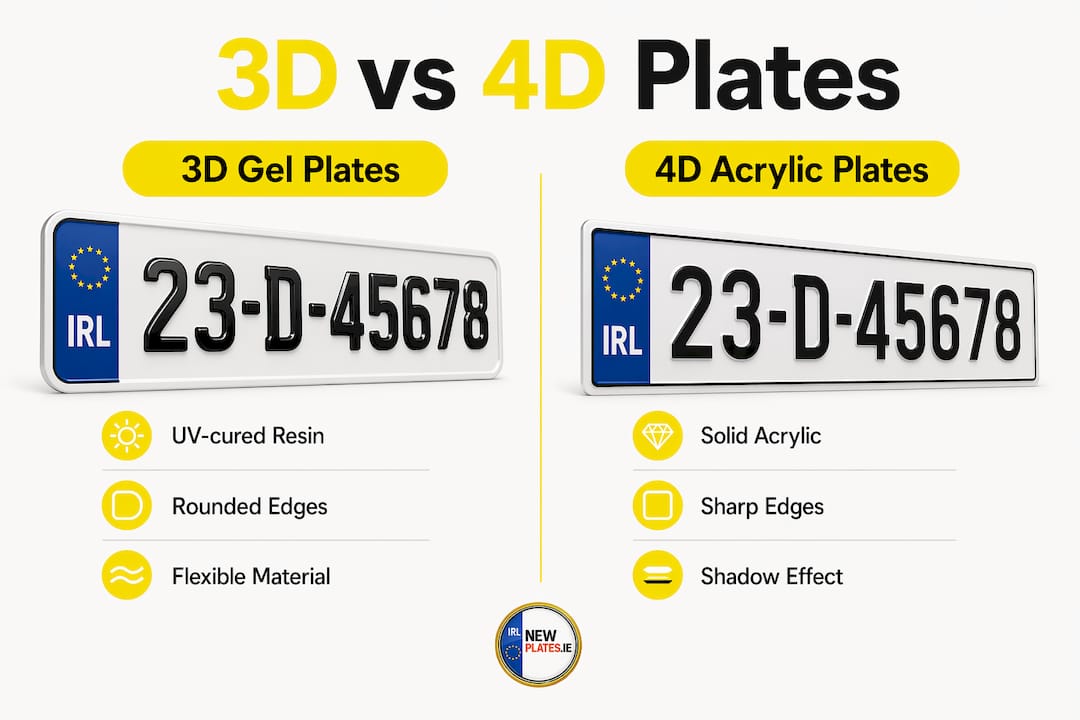
The difference between 3D and 4D plates comes down to one thing: how the characters are built. 3D plates use UV-cured resin gel characters with rounded, domed edges sitting 1–2mm off the plate surface. 4D plates use solid black laser-cut acrylic characters with sharp, 90-degree edges standing 3mm or 5mm tall. Both styles can be fully road legal in Ireland when manufactured to the correct standard, but they look and feel noticeably different in person. If you are trying to decide which one suits your car, this guide covers the materials, visuals, legal compliance, and maintenance for each.
What is the difference between 3d and 4d plates?
The core distinction is material and manufacturing method. 3D gel characters sit 1–2mm off the plate surface, formed from UV-cured resin poured into a mold and bonded to the plate backing. The result is a smooth, rounded edge with a glossy finish that catches light softly. 4D characters are a different animal entirely. They are cut from solid black acrylic sheet using a laser, then bonded to the plate with automotive-grade adhesive. The edges are sharp and precise, and the characters stand 3mm or 5mm proud of the surface.
The term "4D" refers to the physical depth of the acrylic characters combined with the shadow effect they cast in sunlight, creating a perceived fourth dimension of depth beyond simple measurement. That shadow effect is what makes 4D plates look so striking on a dark-colored car in good light. 3D plates, by contrast, offer a subtler upgrade over a standard flat plate. They read as premium without being loud.
Neither style is inherently superior. The right choice depends entirely on your vehicle and what you want the plate to say about it.
How do materials and manufacturing set these plates apart?
The table below captures the key technical differences between the two plate types at a glance.
| Feature | 3D Gel Plates | 4D Acrylic Plates |
|---|---|---|
| Character material | UV-cured resin gel | Solid black acrylic |
| Character thickness | 1–2mm | 3mm or 5mm |
| Edge profile | Rounded, domed | Sharp, 90-degree angles |
| Production method | Molded and poured | Laser-cut and bonded |
| Visual style | Glossy, subtle | Bold, architectural |
The manufacturing process shapes everything about how these plates perform over time. Resin gel is flexible by nature, which means 3D characters absorb minor impacts without cracking. Acrylic is rigid, which gives 4D plates their sharp definition but also makes the adhesive bond critical. Proper automotive-grade adhesive bonding is the single most important quality factor for 4D plates. A poor bond risks the acrylic edges lifting during an automated car wash, which is both a safety issue and a compliance problem.
Both plate types use the same reflective backing material and must be produced on a substrate that meets Irish road standards. The characters sit on top of that backing. The backing itself does not change between 3D and 4D. What changes is everything above it.
Pro Tip: When ordering 4D plates, always ask your supplier whether they use automotive-grade adhesive specifically rated for outdoor temperature cycling. Ireland's wet winters and occasional warm summers put real stress on bonding materials.
How do 3d and 4d plates look different on a vehicle?
Visual impact is where the two styles diverge most clearly for most drivers. Here is how each one behaves in real-world conditions:
- 3D gel plates produce a soft, glossy "wet" look. The rounded edges catch light from multiple angles, creating a gentle shimmer. The effect is subtle enough that many people describe it as a factory-style upgrade. It suits everyday cars, family vehicles, and anyone who wants a cleaner look without drawing attention.
- 4D plates create a sharp, high-contrast appearance. The bold shadow effect from the raised acrylic edges becomes especially pronounced in direct sunlight or under artificial lighting. The characters look almost three-dimensional in a way that photographs well and reads as premium from a distance.
- Light interaction differs fundamentally. Gel characters diffuse light across their curved surface. Acrylic characters reflect light off flat faces and cast defined shadows from their vertical edges. The result is that 4D plates look more dramatic as lighting conditions change throughout the day.
- Vehicle pairing matters more than most buyers realize. A 3D gel plate on a silver family hatchback looks clean and considered. A 4D 5mm plate on a matte black performance car looks genuinely striking. Put a 4D plate on a beige economy car and the effect can feel slightly out of place, though that is entirely a matter of personal taste.
The 3D vs 4D plates debate often comes down to this: do you want your plate to whisper or speak up? Both are valid choices.
Are 3d and 4d plates legal in ireland?
Both 3D and 4D plates are fully road legal in Ireland when they comply with the correct manufacturing standard. The standard that governs plate production in Ireland is BS AU 145e:2018, which specifies font, character spacing, reflective background materials, and near-infrared (NIR) compatibility. Plates must display the Charles Wright 2001 font at the correct digit height and spacing. They must also carry the RNPS (Registered Number Plate Supplier) identification of the manufacturer.
The key compliance points every buyer should verify:
- Font: Charles Wright 2001 only. No stylized, italic, or decorative fonts.
- Character spacing: Fixed spacing as specified under BS AU 145e:2018. Altered spacing to spell names or words is illegal.
- NIR compatibility: The reflective background and character materials must reflect near-infrared light correctly for Garda ANPR cameras.
- RNPS identification: The plate must display the supplier's registered identification number.
- Character color: Black characters on white (front) or yellow (rear) reflective background.
ANPR cameras read the contrast between characters and background rather than character thickness. Compliant 4D plates are fully readable by ANPR systems because solid black acrylic absorbs infrared light correctly. The 3mm or 5mm height of the characters does not interfere with recognition at all. Problems arise only when plates use non-standard fonts, incorrect spacing, or non-compliant materials. A plate that fails any of those tests is illegal regardless of whether it is 3D, 4D, or flat standard.
Non-compliant plates can result in a fine from the Gardaí and a requirement to replace the plate before the vehicle passes its next NCT. That is an avoidable expense, so verifying compliance before you order is worth the two minutes it takes.
What are the maintenance and cost differences?
Maintenance and price are practical considerations that often tip the decision for everyday drivers.
On the cleaning side, 3D gel plates are the easier option. The rounded resin edges do not trap road grime the way sharp acrylic corners do. A standard rinse and wipe keeps them looking good. 4D plates require slightly more attention. Dirt and road film settle into the tight angular corners around each character, particularly after motorway driving in wet conditions. A soft brush and soapy water clears it out without damaging the adhesive bond, but it takes a little more care than a quick hose-down.
Pro Tip: Avoid high-pressure jet washing directly at the base of 4D characters. The force can work under the adhesive bond over time, especially on older plates or those fitted in cold weather when adhesive flexibility is reduced.
On cost, 3D gel plates are generally more affordable than 4D options. 4D 3mm plates sit at a premium price point, and 4D 5mm plates are the highest tier. The price difference reflects the cost of laser-cutting equipment and the thicker acrylic material. For most drivers, the jump in price from 3D to 4D 3mm is modest enough that it comes down to preference rather than budget. The 5mm option is genuinely a premium product and is priced accordingly.
Durability favors 3D gel for impact resistance. The flexible resin absorbs minor knocks without cracking. Acrylic is harder but more brittle under sharp impact. For vehicles that park in tight urban spaces or take the occasional shopping cart to the bumper, 3D gel holds up better over time.
Key takeaways
The right plate type depends on your vehicle, your visual goals, and how much maintenance you want to do. Both 3D and 4D plates are fully road legal in Ireland when manufactured to BS AU 145e:2018.
| Point | Details |
|---|---|
| Core material difference | 3D uses rounded resin gel at 1–2mm; 4D uses sharp laser-cut acrylic at 3mm or 5mm. |
| Visual impact | 3D offers a subtle glossy look; 4D delivers bold shadow effects and architectural definition. |
| Legal compliance | Both types are road legal in Ireland when using Charles Wright font and NIR-compatible materials. |
| Maintenance | 3D gel is easier to clean; 4D requires careful attention to sharp corners and adhesive bonds. |
| Cost | 3D gel is generally more affordable; 4D 5mm is the premium tier with the highest price point. |
My take after years of watching drivers choose
I have seen a lot of drivers walk in convinced they want 4D plates because they look incredible in photos online. Most of them are right. But a few of them come back later having realized that a 4D 5mm plate on a ten-year-old silver Volkswagen Golf does not quite land the way they imagined. The plate is beautiful. The car just was not ready for it.
My honest advice is this: match the plate to the vehicle's personality. If your car is a daily driver that lives in a muddy driveway and goes through an automated car wash twice a month, 3D gel is the smarter choice. The rounded edges resist dirt, the flexible resin handles minor impacts, and the result still looks far better than a flat standard plate. If your car is a performance vehicle, a prestige model, or something you genuinely take pride in presenting, 4D is worth every cent of the premium. The shadow effect in good light is genuinely impressive.
The one thing I would never compromise on is compliance. There is no point spending money on a premium plate that fails the NCT or gets you a conversation with the Gardaí. Always verify that your supplier is RNPS registered and that the plate carries the correct font and spacing. A good supplier will make this easy. A supplier who cannot answer those questions clearly is one to avoid.
— Patrick
Get your 3d or 4d plate from Newplates
Newplates offers both road legal 3D gel plates and road legal 4D plates for Irish drivers, with full compliance to BS AU 145e:2018 and RNPS supplier identification on every plate. Whether you want the subtle gloss of a 3D gel character or the bold architectural look of a 4D 5mm acrylic plate, Newplates has both options ready to order. Prices start from €15.99 for standard plates, with 3D and 4D options available at competitive price points for cars, motorbikes, and custom show plates.
Browse the full range at Newplates and find the plate that fits your vehicle, your style, and your budget. Every plate ships with the compliance details you need to drive with confidence.
FAQ
What is the main difference between 3d and 4d plates?
3D plates use UV-cured resin gel characters with rounded edges sitting 1–2mm off the surface. 4D plates use laser-cut solid black acrylic characters with sharp edges standing 3mm or 5mm tall.
Are 4d plates legal in ireland?
Yes, 4D plates are fully road legal in Ireland when they use the Charles Wright 2001 font, correct character spacing, NIR-compatible materials, and carry RNPS supplier identification under BS AU 145e:2018.
Do 4d plates work with ANPR cameras?
Compliant 4D plates work correctly with Garda ANPR cameras. ANPR systems read contrast between characters and background, not character thickness, so the 3mm or 5mm depth does not affect recognition.
Which plate type is easier to maintain?
3D gel plates are easier to clean because rounded resin edges resist dirt accumulation. 4D acrylic plates require more careful cleaning around sharp corners where road grime can settle.
Are 3d plates cheaper than 4d plates?
Generally yes. 3D gel plates are mid-range in price, 4D 3mm plates are premium, and 4D 5mm plates are the highest price tier, reflecting the cost of thicker acrylic material and laser-cutting production.